

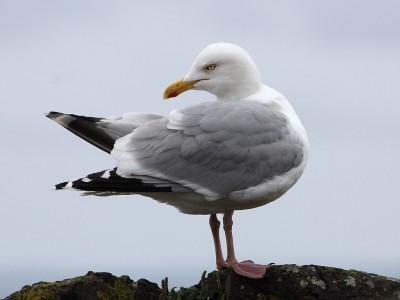
Gulls (lat. Laridae)
The majority of the Laridae belong to the Larus genus that sometimes is referred to as gulls.
Description: Gulls are medium sized birds. Adults are white, more or less dark in the top areas; young ones are speckled and brownish. Gulls have long but rather broad and sharply-pointed wings. Tails are medium sized and straight cut, sometimes having a shallow dent. Gulls have strong beaks hooked at the tip with knobbed mandibles. The plumage varies depending on the season and, especially, age.
Habitat and Behavior. Gulls are capable of both powered searching flight and soaring. They are good at swimming and walking, but they are bad divers, so they dive rarely. They are omnivorous; they often feed on refuse. Large gulls are active predators. Gulls usually nest in colonies forming large groups when resting and feeding.
There are 45 or 46 species of gulls in the world; 23 of which can be found in Russia, 17 – in the Far East
Gulls are the most famous seabirds, they symbolize sea and sea travels. These are beautiful perfect looking avians; however, people do not often notice that – we have become accustomed to gulls, just as we are used to pigeons.
Gulls can be called generalists among the seabirds. They can do almost anything in terms of seabirds’ ‘occupations’. They have tireless light elegant flight; they can soar. They are confident when pattering on ground. They are perfect swimmers. The only thing they cannot do is dive; they can only go underwater for about half a meter, and they struggle even at that.
The other ‘generalist’ feature is their omnivorous nature. They are fishers, predators, scavengers. They are also extremely compliant toward humans. They benefit from the human activities more than any other seabird, and their numbers boost from the environment protection measures.
Gulls, especially the small sized species, have many enemies. However, their aggressiveness and bravery (especially when displayed by entire groups) allow them to fight off even the largest predators. A numerous flock attacking all at once, making loud noises and sometimes using droppings as a method of distraction can scare off any adversary. Black-headed gulls successfully drive away crows and serve as protection for the water birds breeding and tending to their chicks.
V.P. Shuntov, Difficult Job of Being an Albatross.
There are 17 species of gulls in the Far East:
- Black-headed gull
- Little gull
- Saunders’s gull
- Bonaparte’s gull
- Brown-headed gull
- European herring gull
- Slaty-backed gull
- Glaucous-winged gull
- Glaucous gull
- Mew gull
- Black-tailed gull
- Sabine’s gull
- Black-legged kittiwake
- Red-legged kittiwake
- Ross’s gull
- Ivory gull
- Pallas’s gull
Five species do not nest in the Sea of Okhotsk region: glaucous-winged gull, glaucous gull, black-tailed gull, Ross’s gull and ivory gull.