

Grayling (lat. Thymallidae)
Order: Salmoniformes
Family: Thymallidae
Genus: Thymallus
Graylings are freshwater predator fish found in the Northern Hemisphere. One of the most beautiful species found in Russia.
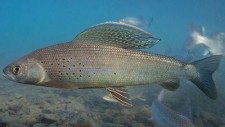
Description. Graylings are very similar to salmons and whitefishes; however, their dorsal fins have longer base, they are higher and resemble a flag or a plume; they are also often brightly colored. Graylings are usually 25 to 30 cm long and weigh around 500 grams.
Status. Graylings are an object of local trade and recreational fishing. Some populations are endangered.
Habitat and Behavior. Graylings occupy the rivers of Europe, North Asia and North America. There are several species of graylings. They keep to rocky rifts and feed on insects and insect larvae, crustaceans, shellfish, small fish and roe. There are several subspecies living in the rivers of the Far East: the Amur grayling and the East Siberian grayling. The East Siberian grayling can be identified by its dorsal fin, which has stripes of contrast crimson spots. It is about 45 cm long. It can be found in the Siberian and Far Eastern rivers east of Yenisei. The Amur grayling has larger scales. It is dark with dimmer fins. It grows no longer than 42 cm. It inhabits the Kamchatkan rivers, the north and west coasts of the Sea of Okhotsk, Primorye and the Amur river basin. Learn more: Graylings live in mountain rivers with clear cold water, and in lakes, somewhere around 2000 to 2300 meters above the sea level. Graylings feed on the zoobenthos: larvae and imago of caddis fly, stone fly, day fly, and chironomids; when its warm they also feed on flying insects. Some species eat other fish, and the biggest specimens can even catch small rodents. Freshly caught grayling has a distinct smell that reminded the first naturalists the smell of thyme (lat. thymus), thus their scientific name. The Russian name – ‘kharius’ – has Finnish origins. Harjus in Finnish is derived from harju, which means ‘mountain ridge’. Leonid Sabaneev, a Russian zoologist, stated that graylings are one of the most beautifully colored species of fish in the majority of the Northern Hemisphere.
* * *
“Grayling’s color, however, varies greatly: in strong currents they are much lighter; in the deep they have a more steel shade. It is very hard to spy them out in the water since they practically merge with the ground and rocks. […] Graylings mostly live in mountain regions, and, together with trout, represents the major fish population of cold strong rivers almost all over Europe, northern and north-eastern regions of Russia, and the entire Siberia, where it can also be found in lakes. Graylings are very alert and lively, and would not lose to trout in this respect. There is a reason the French call them l'ombre – they can disappear like a shadow. When it is sunny, they often jump out of the water with their rainbow fins glistening in the sun, and catch the insects that fell on the water surface.” Extract taken from: Leonid Sabaneev, Freshwater Fishes and Their Catching.
* * *
“Beautiful graylings remind me of butterflies in some way: either it is their iridescent colors, or the broad fins that catch snow. The fish fall asleep after jumping around, and the rainbows on their sides fade: rose violets and piercing blues make way for brown; living iridescent shades change for stillness.”Extract taken from: V. I. Klippel, The Smile of Jugjur .