

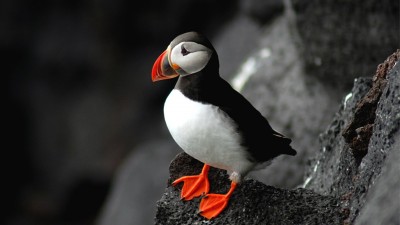
Tufted Puffin (lat . Fratercula cirrhata)
Tufted puffins are sometimes called parrots or clowns for their unusual appearance.
Description. They are 39 cm long and have wingspan of 70 cm. Adult birds are mostly brownish back. In summer their heads are white on the sides, and there are tufts (‘braids’) of long yellow feathers behind the eyes. They have large red beaks flattened on the sides with greenish base. There are rough patches of orange red skin in the corners of the mouth. Tufted puffins have red legs.
Status. Tufted puffins are an abundant nesting species. They spend winters in the Pacific waters of Kamchatka, the Commander and Kuril Islands, as well as along the southern coast of Sakhalin and in the Peter the Great Gulf.
Habitat and Behavior. They nest in colonies of various sizes, sometimes also in couples, in islets and coast cliffs. They build nests in lodges, less often in rock splits and hollows between the rocks. In winter most of the birds keep to the open ocean waters.
Similar Species. Other auks also have the same large and brightly colored beaks. Young tufted puffin may be mistaken for the rhino auklet, which has a lower beak and a larger head. They also resemble horned puffins, which can be identified by their contrast two-toned appearance with a sharp border between the upper black and the lower white parts, and yellow beaks during the mating season.
In winter tufted puffins’ heads are dark on the sides, and instead of tufts behind the eyes there are light spots. There are not skin patches in the mouth corners, and the base of the beak lowers down a bit and turns brown.
Young puffins resemble the adult ones in their winter colors; however, young ones have lighter chests and bellies, sometimes completely white; their beaks are lower and brownish. By their first summer the top of the beak turns orange. Their irises are brownish, so their eyes seem dark, even though adult birds’ eyes are light yellow.
* * *
“Meeting the tufted puffin, the third most abundant species among the Pacific bird colonies, sometimes may be unexpected. It is hard to see these birds during the day. Unlike murres, tufted puffins build their nests in holes and splits. But if an alarm is sounded, they climb out of their burrows and start looking around. If they see the threat is up close, they gather on water next to their cliff.
They are rather unsociable. Somewhat nasal grumbling can be heard from their burrows. It is not a good idea to stick bare hands in the nest when the occupants are at home: their mighty beaks are a serious weapon.”
S. Makarov, Cand. Sc. (Biology), Yuny Naturalist journal, 1969, No. 3