

Taimen (lat. Hucho taimen)
Order: Salmoniformes
Family: Salmonidae
Genus: Hucho
Freshwater species. Taimen is the biggest species among the Salmonidae. It was also known as Siberian taimen.
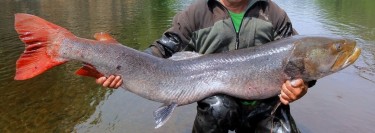
Description. Taimen can grow up to 1 m long and weigh 80 kg. There are records of taimen of 210 cm and 105 kg being caught. This species is mainly differentiated from other Hucho species by red anal, adipose and tail fins, and big size.
Taimen have low long bodies and large mouths. The colors grow from olive green on the head to reddish brown on the tail. Bellies can range from almost white to dark grey. Sides and the top of the head are covered in small dark spots. Young taimen retain lateral stripes on their sides. When spawning, the entire body becomes copper red.
Status. Taimen are among the most popular game for recreational fishing. The species need protection with some populations being endangered.
Habitat and Behavior. Taimen inhabit rivers with strong currents and open cold water lakes, and never go out at sea. In Russia taimen can be found in extensive territory from the piedmont of the Ural Mountains to the eastern outskirts of Yakutia and southern regions of the Far East (rivers Yana, Aldan, Uda, Tugur, Amur and its tributaries). Taimen are typical predators. They mostly feed on fish, but also frogs, water birds and small rodents.
Taimen are typical predators. Underyearlings will completely switch to feeding on fish from their third year. Taimen usually grows 62 to 71 cm long and 2100 to 3800 grams by the age of 6 or 7 years. They reach sexual maturity at the age of 5 to 7 years, growing 55 to 60 cm long. Taimen live 10 years on average; however, the oldest taimen was recorded to be 55 years old.
In summer they keep to small tributaries, and in winter they migrate to the main corridors of big rivers or to lakes. The spawning season is in May, in northern regions – in June. Taimen leave large rivers for spawning and go up the small rivers and creeks. Spawning grounds are located in areas with strong current and rocky pebbled soils. Females lay eggs up to 1 m deep at the temperature of 7 to 8°С in so called ‘nests’ dug in the ground.
After spawning taimen scatter over tributaries; some seem to go down to large rivers where they gain weight in summer keeping to the deep areas. When winter comes, they leave small tributaries for larger and deeper rivers.
Taimen inhabiting large lakes spend summers in those lakes, but go to tributaries for spawning. The biggest specimens stay in the lake and spend winters in the deep.
Aleksey Tsessarsky, Rybak-Rybaka newspaper, No.40-43 (October 2005)
* * *
“…He drew the line almost up to the side of the boat, and we saw that something resembling a red-finned shark was calmly following the lure, lazily moving its tail and fins. It did not take the lure, but it stayed by the boat for a couple of seconds examining us in a somewhat strict manner, and then disappeared under a century-old curve with a dignified tranquility. It faded in the depth like a specter. An old experienced fish it was, and seemed to know all there is to know about tough luck.
I am certain that giant was a couple of meters long, but I will shave off some twenty centimeters just to be on the safe side, not more. I cannot imagine how much it must have weighted, but if I had to hazard a guess, I would say over fifty kilograms. And what a huge head it had! What a broad back! What a mighty tail – one move made the entire boat dance! A log! A crocodile! What a majestic outline of the mouth, what an imperially terrifying gaze!”
Extract taken from: Sergei Kucherenko, Fish At Its Home.