

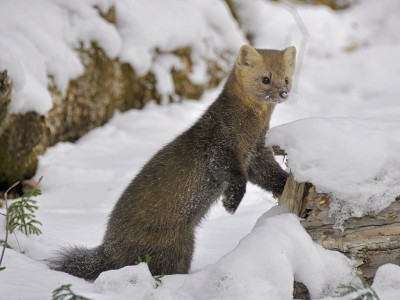
Sable (lat. Martes zibellina)
Description. Sables have a body length of 32 to 58 cm and a tail length of 9 to 17 cm. They weigh 0.9 to 1.8 kg. They have elongated bodies and relatively short legs. They show a distinct sexual dimorphism between males and females in terms of size. Fur color is uniform; it ranges from sand yellow to brownish black. Sometimes there is a blurred yellowish patch of fur on a sable’s throat and chest. Their heads are usually lighter than their backs. The colors, fur quality and body sizes vary significantly for different regions of habitat. There are few geographically distinguished forms: small sables that inhabit the Far East and Baikal regions; larger ones are found in Kamchatka.
Status. Sables were practically driven to extinction; but their numbers and habitat have been restored. It is a common species in the majority of its habitat. Sables are a valuable object of fur trading and fur farming.
Habitat and Behavior. Sables inhabit the entire taiga zone of Eurasia from northern piedmont of the Ural Mountains to the Pacific coast and nearest islands. The majority of the habitat is located in Siberia and the Far East. Sables can be found in Mongolia, Korea, north-east of China, and Hokkaido (Japan). They live in mountain and lowland taiga, mostly in cedar, spruce and fir forests. Sables feed on various animals and plants. They mostly prefer to stay on the ground level, and rarely climb up the trees.
Similar Species. Sables resemble the European pine marten and beech marten. However, sables can be distinguished by a less prominent spot on their throats (or a complete lack thereof), and a relatively short tail (no more than half of the body length) that extends only for ¼ of its length over the hind legs. The bone structures of auditory bullas are elongated and drawn closer together as compared with martens – in their case, those are short and wider placed.
There are three subspecies of sable found in the Far East: the Yakut sable, the Far Eastern sable and the Kamchatka sable.
The Yakut Sable
Обитает в Хабаровском крае и Амурской области. Волосяной покров низкий, но исключительно шелковистый. Общий тон окраса темный. Географическое распространение – тайга верховий Алдана, Зеи и на восток до реки Уда.
The Far Eastern Sable
These sables are rather small and relatively light-colored. Males reach 390 to 440 mm in length (including body and head), and females are 360 to 390 mm. As for the tails, males usually have 115-145 mm long ones, and females – 110 to 125 mm. Kuznetsov distinguished three forms of this subspecies: the Sakhalin, the Ussurian and the Shantar sables. They inhabit the Primorye Territory, the eastern areas of the Amur Region, and Sakhalin.
The Kamchatka Sable
These sables are larger than the other subspecies, and have more massive heads. Males reach 445 to 580 mm in length (including body and head), and females are 415 to 510 mm long; their tails are 120 to 160 mm long. They vary in color; however, dark brown prevails. Their fur is very long, but not very soft. They live in Kamchatka and the north region of the Apuka river.
***
The sables’ main ‘asset’ that brought so much misfortune to them from humans is their valuable fur. Siberians have paid their levies using sables for centuries: first, to the Chinese, then to Mongols. After Russia expanded to Siberia, it obtained the fame of being the sable owner and producer. Sables began to be called ‘Russian’, and their skins turned to be the necessary part of embassy gifts. Sable fur was used in hats, fur coats and coat linings. It was considered prestigious and luxurious to ‘wear sables’ both in Russia and in Europe. High demand and low prices set by the buyers lead to truly horrible scopes of the sable fur trade. Naturally, the sable numbers dropped abruptly.
It is notable that local populations had an opposite approach to the sable fur. Siberians considered it practically rubbish and rarely used it for warm clothes that are crucial in that climate. Fur coats called ‘kukhliankas’ were usually made of wolf or deer skins; whereas sable fur was used to line the bottom sides of skis. And the very rules for the sable hunt were different from those set by the Europeans. Local hunters tried to maintain the numbers, spared pregnant females and younglings, and hunted in each known sable-inhabited area only every four years. They still tell tales of excessively greedy hunters being punished by the spirits for killing too many sables.
Consequently, sables suffered least of all in those areas (Barguzin in the Transbaikal Territory, and Kronoki in Kamchatka) where the hunting grounds were legally assigned to their historical owners, the local populations, during the uncontrolled period of the fur trade.
The Soviet Government prohibited sable trade completely in 1935 for 5 years, only to allow strictly licensed winter hunting after that. Just as it was with the American mink, only to a lesser extent, sables became object of fur farming. Natural reserves and conservation areas (such as Barguzinsky, Kondo-Sosvinsky or Altai ones) were established in order to restore the sable population. From these areas sables spread on their own to the neighboring territories; and here they were caught to be sent to those regions where they became extinct – to the Shantar Islands, to central Yakutia, to Primorye.
Extract taken from: I.Ya. Pavlinov, Mammals.