

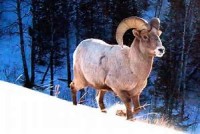
Snow Sheep (lat. Ovis nivicola)
Description. Snow sheep are heavy-built, medium sized animals. Their bodies are up to 180 cm long, and they reach shoulder height of up to 105 cm. Average weight is up to 140 kg. Females are significantly smaller than males. Males have horns of up to 111 cm long (along the curve) and up to 36 cm thick. Females have small, relatively insignificant horns. Snow sheep are usually brownish or reddish brown.
The biggest specimens can be found in Kamchatka and the Chukchi Peninsula. Snow sheep inhabiting the Far North are light-colored, the southern subspecies are brownish in various shades. The Okhotsk snow sheep (lat. Ovis nivicola alleni) is easily identified by its shade – dark, richly saturated colors. Their horns’ point are less curved sideways as compared with the other subspecies.
Status. Certain subspecies are endangered. The Okhotsk snow sheep are common and hunted
Местообитания и поведениеSnow sheep (Ovis nivicola) can be found in North-East Asia and North America. Russia has four subspecies: Kamchatkan snow sheep, Okhotsk snow sheep, Yakutian snow sheep and Putorana snow sheep (also called Norilsk snow sheep in Russian). The Okhotsk snow sheep inhabit the Eastern Siberia along the Yablonovy and Stanovy Ranges and up north to the Verkhoyansk Range. These are social polygamous animals. They occupy the woodless cone slopes and coastal cliffs. They feed on woody and bushy plants, grass and moss. In autumn, winter and spring they keep together in mixed herds of up to 20 individuals, but in summer they separate into sex-specific groups. Herd composition is not constant.
Similar Species. Snow sheep closely resemble Altai argali, but have a heavier build and thicker, more curved spiral horns. They also leave a narrower prints.
Snow sheep stay close to the range ridges and cliff foots. Sometimes in winters they go down to trailing shrub regions. In the Chukchi Peninsula they occupy mid-range and low-hill terrains. In regions where they are not hunted (e.g., in Alaska) snow sheep grow used to people and feed alongside the roads. However, it is usually very hard to come close to them even for a shooting distance needed for a telescope-sighted rifle. Putorana and Chukotka subspecies are are listed in the Red List of endangered species of Russia; however, in other regions snow sheep are an object of sport hunting.
Even though snow sheep, just like all the mountain sheep, are slightly inferior in terms of moving and climbing steep cliffs when compared to chamois or wild goats, they are experts in moving through rockslides. Calmly and graciously do they cross slopes that break down in landslides from as much as a fox running by. It is probably their incredible intuition that helps them picking out steady rocks to put their hooves on. Mountain sheep are rather fast and venture out further from the cliffs than chamois and goats dare to go.
V.L. Dinets, E.V Rothschild, Russian Nature Encyclopedia, —Moscow, ABF, 1998.
*** “I was mesmerized by the rocks and mountains, and I kept thinking that here, at this height and in this wilderness no life may be possible; and then I saw jumping live balls below. One, two, three. Then three more. I realized those were snow sheep. Never before did I see them in their natural habitat. It was hard to believe that these large herbivores manage to find any food on these deadly snow-covered cliffs. But they were here, and they moved around pretty lively. Snow sheep soon disappeared behind a menacing and looming ridge. Our helicopter wailing and moaning took a couple of minutes to cross a narrow flat saddle pass between two gigantic rock formations; and I kept staring at numerous old and fresh prints left by the sheep – dark patches of snow dug down to the ground. I saw rare bush lines and thought about how magnificently undemanding can animals be. I believe snow sheep can take their rightful place next to reindeer and muskoxen as true Spartans of mountain tundra living in such harsh conditions with scarcely any food.”
Extract taken from: Sergei Kucherenko, Animal Tales.