

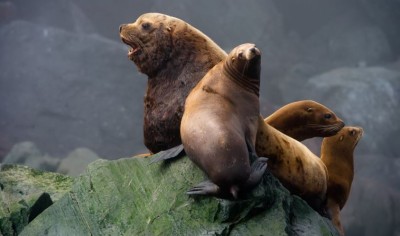
Steller Sea Lion (lat. Eumetopias jubatus)
Steller sea lions are the only species in its genus. They are also the biggest eared pinnipeds.
Description. Males grow 260 to 390 cm long, females – up to 260 cm; they weigh 110 to 350 kg. Males are heavy-built; they have massive bodies and big heads with short broad snouts and upturned noses. Thick skin and long overhair form a mane around the neck that protects males during mating fights. Females a slim; they have relatively small heads and long flexible necks. The overhair is short, sparse and rough; there is little to no fluff. Flippers are bare only on edges. Males have light brown or straw yellow backs, sometimes almost white, and dark brown bellies. Females are more uniformly colored.
Pups are born 110 cm and weigh 20 kg. They are covered in thick soft dark reddish brown fur. Young sea lions resemble adult females, but are darker; whiskers are completely or partially dark, unlike the light-colored adults’ ones.
Status. Rare species, listed in the Red List of endangered species of Russia.
Habitat and Behavior. Steller sea lions can be found along the Asian and American coasts of the northern Pacific. Main haul-outs in Russia are located in the Kuril Islands, the American ones – in the Aleut Islands. Sea lions usually live in coastal waters. At sea they gather in groups; they are rather loud. When surfacing they breathe out loudly and make a splash visible from a distance. They prefer to haul out on cliffy capes and islets. In winter they may rest out on ice. When on the ground, they move using all four extremities; they can also jump rather quickly. Being perfect climbers they often get rather high up the cliffs using barely discernible ledges. When diving, they can easily jump down from significant heights. They mostly feed on fish and cephalopods.
Similar Species. Northern fur seals are identified by their darker shade, significantly smaller bodies and sharp, not upturned snouts. Harbor seals have more or less distinct spotty pattern on their bodies, and they have round heads. At sea they tend to be solitary and quiet, not drawing attention. On land they slide and crawl on their bellies using only the front flippers.
Eared seals (lat. Otariidae) have very distinct ear flaps, hence their name. These are large or medium sized seals with small but distinct ear flaps. They have long front and back flippers; the hinder ones can be bent underneath the body thus helping the animal to move on land. Flippers are dark, fully or partly bare; claws are either poorly developed or none at all. Tails are short and barely visible. Fur consists of two layers: overcoat and fluff. Sexual and age dimorphism is strong; males are significantly larger than females. Eared seals breed on shore forming polygynous groups. They migrate on a seasonal basis. There are 12 to 14 species worldwide, oh which 2 are found in Russian and the Far East.
* * *
In literature…
“When in the morning the fog was gone, we saw the Sakharnaya Golova (Sugar Head) island right before us.
At the foot of the island and on its slopes high sharp cliffs were towering; and right at the water there was a narrow stony beach. Everything – both the beach, and the cliffs – was covered in sea lions: hundreds, perhaps thousands of them.
Gavril Ivanovich stared at them through his binoculars shaking his head. He grew up and aged on a sealing ship, but has never seen these beasts. They were brown, the size of a cow; but they looked like seals, only with ears and manes.
Seals can barely make it on the ice surface; and these climbed all the way up on the cliffs, and even fought each other there. They lunged at each other, bit and hit each other with their huge flippers. And down on the beach small pups crawled around. And all of them, young and old alike, roared loudly.
We sent four lifeboats and a powerboat from the Udar. Took our guns, harpoons, hooks. Decided not to start the engine and rowed to the land. We anchored the powerboat and dragged the boats ashore so that they would not be carried away by the current. And we scattered across the shore in a long line.
The sea lions did not even pay us any attention at first. Only the pups, crawling like lizards, started moving towards water.
However, we only made a couple of shots – and huge beasts started throwing themselves down from those cliffs. It seemed they would definitely crash against the sharp rocks, but no, they just bounced like balls on their flippers, fell down again and moved hastily to the sea. And they gnashed their huge white teeth at us and roared so terrifyingly that young sailors began retreating towards the boats.”
Extract taken from: Andrey Sergeevich Nekrasov, Sea Boots: Short Stories.