

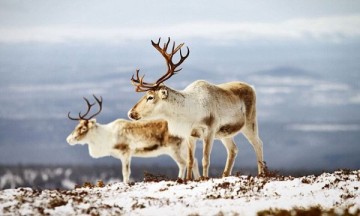
Reindeer (lat. Rangifer tarandus)
Reindeer is the only cervid species in which both males and females grow antlers.
Description. Reindeer are up to 220 cm long and reach shoulder height of up to 150 cm. They weigh up to 220 kg. In winter their fur is thick and long, light-colored, with a well-developed undercoat; and in summer in becomes short and sparse, reddish or grayish brown. Both males and females have antlers. Reindeer have bowl-shaped hooves that splay under load, which allows them to move through snow and swamps.
Status. Certain subspecies are protected. Reindeer are an object of hunt and herding. Domesticated reindeer are also widely used.
Habitat and Behavior. Reindeer inhabit the boreal islands, tundra, lowland and mountain taiga regions of Eurasia and North America. Their large herds migrate seasonally from tundra to taiga and back crossing rivers and lakes. In the south of Siberia they live in taiga. In winter reindeer feed on lichen (mostly, reindeer lichen) and twigs, in summer they eat leaves, sprouts, berries and mushrooms.
Scientists name up to eight subspecies of reindeer occupying the territory of Eurasia. Thus, dark-colored Kamchatkan reindeer (R. t. Phylarhus), the biggest subspecies of the Old World, live in the south of the Russian Far. These reindeer can be found in Kamchatka, Sakhalin, the Jugjur Mountains, the Amur Region and, sometimes, in north regions of Sikhote-Alin.
Another subspecies, a lighter-colored Siberian tundra reindeer (R. t. Sibiricus) inhabits the northern areas of the Magadan Region and north-western areas of the Khabarovsk Territory away from the Sea of Okhotsk.
There are also four breeds of domestic reindeer: Nenets, Even, Evenki and Chukchi.
Wild reindeer living in the Russian Far East are relatively large. Males grow 189 to 205 cm long, weigh 104 to 190 kg, and reach shoulder height of 115 to 125 cm. Females are slightly smaller and lighter. Far Eastern reindeer are darker than other subspecies.
Their overcoats, especially in winter, are thick, hollow and brittle. They form a ‘beard’ around the neck. Broad hooves are surrounded by rough long bristle that increases the bearing surface and facilitates walking on soft soil.
Reindeer are widely spread in tundra zone of Eurasia: from Scandinavia to Kamchatka and Sakhalin. The south border of the habitat is floating. In the Russian Far East wild reindeer are recorded in the northern Magadan Region, the Koryak Mountains, Kamchatka, Sakhalin, coastal mountains of the Sea of Okhotsk and Stanovy Range. Due to wide spread of reindeer herding within the habitat, there are numerous groups of nomadic domesticated reindeer.
They mostly feed on lichen and moss – namely, reindeer lichen, which they dig up from under the snow with their hooves. In summer they feed on dwarf birches, willows, any lichen they can find, boletes, and even lemmings and bird eggs.
Reindeer are a typical herd species. Only the oldest bulls risk wandering around alone. Wild herds are not large: about 40 to 100 individuals. Reindeer are very active and mobile, and they feed practically constantly when moving, both during the day and at night.
They easily survive extremely low temperatures and blizzards. In summer they go out to icing fields and snow beds exposed to wind in order to escape blood-sucking insects.
Bulls shed their antlers after the mating season, in November or December; cows do so after giving birth, in May or June. New antlers grow in April (for males) or right after the old ones are shed (for females). By the end of August antlers finally harden completely.
Reindeer reach sexual maturity when they are 16 or 17 months old. The mating and breeding season takes place from September to November. Pregnancy lasts for 192 to 246 days. Calves (one, sometimes, but rarely, two) are born in May or June.
In tundra and forests reindeer are mostly hunted by wolves, who kill calves more often than mature deer. Sometimes brown bears or wolverines may attack them in woodland. Reindeer also suffer greatly from reindeer warble flies’ and other botflies’ larvae.
Reindeer are an important trade species; people freely shoot them in the areas where wild herds are found. Evenkis call wild reindeer ‘sokjoy’.
Source: Terrestrial Mammals of the Soviet Far East: Guide, Moscow, 1984.
* * *
In literature…
“Reindeer are well equipped for cold and poor regions. They feed on barely noticeable northern cryptogamous plants: reindeer lichen, usnea lichen and other lichens and mosses – occupants of tundra, taiga and open mountaintops. But early in summer they are lucky enough to feast on greens: leaves of bushes and dwarf birches. They have such an acute sense of smell that they find lichen even under a thick cover of snow.
They procure food by digging the snow up with their hooves. And if there is no reindeer lichen to be found, they look for other varieties on the trees, usually hanging from the branches like long mane. Domestic reindeer graze all year round. Their long fur with an incredibly thick undercoat protect them from extremely low temperatures and cold winds. And as for their ability to move through deep snow, reindeer are unsurpassed masters. Look at their hooves: the bearing surface is almost twice as wide as any other deer have. And when running, their hooves splay under load, thus increasing the bearing surface – and so, they do not get stuck even in the dry loose snow.
Perhaps, no other even-toed ungulate species can compete with the reindeer in terms of their stamina. They manage perfectly in south Siberian highlands, in taiga, and in the Far North, where the habitat reaches the Arctic Ocean coast. It is hard to imagine a faster animal for the sledge. They extend their necks, raise their heads laying the antlers on their backs and run like the wind, almost fly. The sledge barely touches the ground. Snow jets from under their hooves, and a thick white cloud-like steam blows from their noses covering their heads. And it seems they can run forever.”
Extract taken from: Grigory Fedoseev, In the Clutches of Jugdyr.