

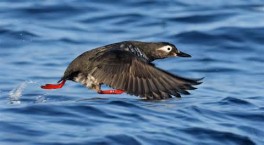
Spectacled Guillemot (lat. Cepphus carbo)
Unlike other species of guillemots (black guillemot and pigeon guillemot), the spectacled guillemot is the only one to build nests in the northern regions of the Sea of Okhotsk.
Description. They have 38 cm long bodies and wingspan of 69 cm. Their plumage is grayish black with white spots around the eyes (hence, their name). They have black beaks and red mouths and legs. In winter they grow lighter; and the white spots around the eyes become thinner. Young birds resemble the adults in their winter plumage, but their bellies have brownish lateral specks.
Status. Common nesting species. Their main habitat is the coastal area and islands of the Sea of Okhotsk and the northern region of the Sea of Japan; only individual couples nest along the eastern coast of Kamchatka. Spectacled guillemots spend winters in the nesting habitat where the sea does not get covered in ice.
Habitat and Behavior. Spectacled guillemots are coastal birds. They nest in sparse colonies or individual couples along the mainland coast and islands in the loose rocks and cliff splits. In winter they are less tied to the coastal line than in summer; however, they still tend to keep to the shelf area.
Similar Species. Pigeon guillemots are smaller and have relatively shorter and thinner beaks. They have white spots on their wings and no spots around the eyes. In winter their backs and chests are less contrasted.
There are three species of guillemots giving name to the entire family. Black guillemots (lat. Cepphus grylle) live in the Arctic and North Atlantic regions, being replaced in the North Pacific by pigeon guillemots (lat. Cepphus columba). The third species, the spectacled guillemot (lat. Cepphus carbo), inhabits the Sea of Okhotsk and the Sea of Japan, along with the adjacent areas. In summer they are usually black with bright red feet. The former two species have distinct white spots on their shoulders, and the spectacled guillemots have spots around their eyes. When young or during winters they are all light colored and speckled.
Guillemots feed on fish and small invertebrates. They dive for their food. More than other auks they hunt near the shore and in the bottom layers. Thus, they feed on variety of bottom fish and invertebrates.
Savva Uspensky, a renowned Arctic researcher, describes the guillemots hunting in his Living Arctic (“Живая Арктика”): “It is sometimes possible to observe the birds fishing from the coastal cliffs. Diving and flapping their wings, guillemots ‘fly’ through water. They do, in fact, seem to be genuinely flying: to such an extent do their movements underwater resemble flying. Reaching the bottom, they carefully examine all the rocks, even look underneath. From time to time they appear on the surface with small fish or shellfish in their beaks. They do not, however, swallow those right away or fly with them to their nests. First, they ‘rinse’ their catch submerging it by ducking their heads several times.” It is possible that this habit served as the reason for naming this bird (in Russian it is called ‘chistik’, derived from ‘chistit’ meaning ‘to clean’) and their entire family.
V.P. Shuntov, Difficult Job of Being an Albatross.