

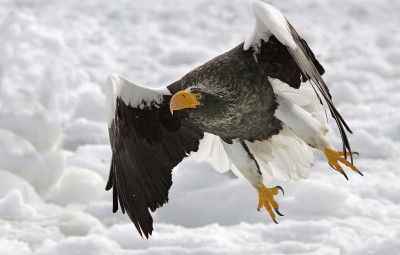
Steller’s Sea Eagle (lat. Haliaeetus pelagicus)
Steller’s sea eagles are large birds of prey that nest only in Russia.
Description. The biggest species of the sea eagles. They have incredibly massive beaks. The total length reaches up to 112 cm, wings are up to 68 cm long, weight – up to 9 kg. Steller’s sea eagles have average wingspan of about 2.5 meters. They have wedged tails. The plumage is brown to black. The tail, forehead, feather cover on the legs and bend areas of the wings are white. Steller’s sea eagles have bright yellow cered beaks, irises and feet. Males and females have the same plumage. Young birds are dark with no white spots; ‘shoulders’ become white only by the age of 5 to 8 years.
Status. Rare species endemic to the Far East. Steller’s sea eagles are listed in the Red List of endangered species.
Habitat and Behavior. Steller’s sea eagles nest along the coastlines of the Far Eastern seas and along the spawning rivers and lakes of Kamchatka, the Okhotsk coast and downstream Amur. They can be found in the Shantar Islands. They spend winters on the sea coast, and sometimes in taiga regions of the southern Far East. Outside of Russia Steller’s sea eagles can only be seen during winter migrations. They feed mostly on fish, but also birds and carrion washed out by the sea.
Similar Species. Their closest relatives are smaller white-tailed eagle and bald eagle. When flying the Steller’s sea eagle can be identified by its rounded back edge of the wings.
The Steller’s sea eagle’s entire life is tied to water, so about 90% of the nests are no further from the shore than 0.5 km. Their nests are huge: the average diameter is about 1.6 m, and they can be up to a meter high. Sea eagles build their nests high up trees, and on cliffs along the shores; they return to their nests every year.
* * *
“Spreading their mighty wings they circle higher and higher. You can hear them squawking: “Kik-kik-kik…”
«Кик-кик-кик…»
It seems they are out flying together for the first time after being separated by winter season, and they decided to glance from up high at their native mountains and river. And then, all of a sudden, they lunge at each other, soaring up even higher, and fall down like stones, still tangled and locked.
We stopped expecting to see them crash. But right above the treetops they flew apart and began circling back up again.”
Extract taken from: Grigory Fedoseev, Taking the Challenging Path.