

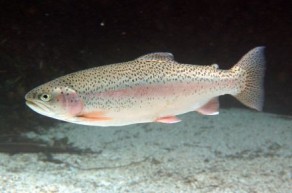
Kamchatkan Rainbow Trout (lat. Parasalmo mykiss)
Also known as rainbow trout, or Kamchatkan trout; ‘mikizha’ in Russian. A beautiful fish of the Salmonidae family. There are two forms: anadromous and freshwater.
Description. Rainbow trout’s specific feature is a crimson, red or pinkish line that goes along the sides and the gill covers. It gets brighter during the spawning period. The trout’s belly is usually silvery white, and their backs have a greenish shade. There are numerous small dark spots on the body and the fins. The freshwater form is brighter colored than the anadromous one.
Habitat and Behavior. Freshwater Kamchatkan trout (‘mikizha’) can be found mostly in the rivers of Kamchatka. There is also a remnant freshwater population in the Bolshoi Shantar island. The anadromous form (more commonly known as the Kamchatkan trout) comes for spawning to small tundra rivers of Kamchatka in autumn, sometimes, but rarely, - to the water bodies of the mainland coast of the Sea of Okhotsk. The species spends winters in low and middle streams in holes. The spawning season falls on spring.
Status. Valuable species. Perspective object of game fishing and industrial culture (may grow up to 8 kg). Anadromous form and mikizha from the Shantar Islands are listed in the Red List of endangered species of Russia.
Freshwater variety (mikizha) lives everywhere in Kamchatka, but is most abundant in the tundra water bodies of the eastern coast. It tends to keep to the main corridors of rivers and large streams, but also lives in lakes. Fry spreads all through the tributary systems. The biggest freshwater mikizha (60 cm long and 3 kg in weight) was caught in Azabachye lake in eastern Kamchatka. On average mature fish of various populations may be 20 to 40 cm long and may weigh 150 to 1900 grams. Most fish reach maturity at the age of 5, some at the age of 4 years. They breed every year, once to four times in their lives. The spawning migration starts in spring along with the intense thawing of snow and ice. The spawning itself occurs from May to June.
Anadromous variety (Kamchatkan trout) is mostly large, up to 1 m and 10 kg. It lives in Kamchatkan water bodies, and sometimes can be found in waters of the mainland coast of the Sea of Okhotsk. It comes to small tundra rivers for spawning from September to November. It spends winters in low and middle streams in holes, and then continues its migration in spring upstream towards the spawning grounds. It lives for 10 or 11 years, matures at the age of 4 or 5, and breeds from one to five times. After the first spawning the majority of the fish dies. They live for 1 to 4 years in rivers, and from 2 to 6 years at sea. Adult trout does not feed in rivers; when at sea they eat large invertebrates and other fish. Along the North American coast, anadromous form is known from Alaska to California.
Shantar resident mikizha is a freshwater variety. Adult fish grows 26 to 49 cm long. They inhabit the Severnaya tundra river on the Bolshoi Shantar island. The oldest fish was recorded to be 14 years old. They feed on flying insects, water inspect larvae, fish and field mice.
***
“There is little known about fishing the Kamchatkan trout and mikizha. These varieties are rare, part of the Red List, and it is strictly prohibited to catch them. Naturally, it does not mean that no one ever goes for it. It is just that Kamchatka, where their habitats are, is too far away and underpopulated – and local fishers are not inclined to share their knowledge with the rest of us.”
Extract taken from: Anton Shaganov, Salmons.