

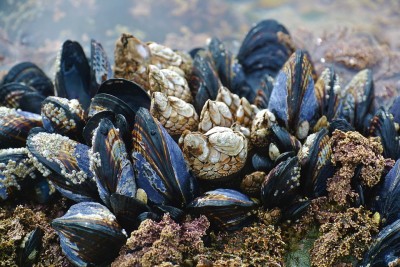
Mussels (lat. Mytilus)
Description. Shells are up to 20 cm long, wedged or oval in shape, smooth, dark violet, brown and yellowish green in color, nacreous inside. Mature mussels no longer use the foot for moving; they use byssal threads (‘beard’) to attach themselves to a solid substrate or to each other clumping together and forming groups.
Status. Object of trade. Mussels are used as food product and an ingredient of fine offal. Mussels are also a source of food for marine fish (mostly, fry).
Habitat and Behavior. Two species – common (or blue) mussel (Mytilus edulis) and bay mussel (M. trossulus) – are found in the Russian Far East waters. They inhabit the marine and salty waters, mostly the intertidal zone of 150 to 200 m deep. They can live on various natural substrates, including rocks, cliffs, and shells of other mollusks. The feed by filtering out small organisms and organic substances from the water that goes through their brachial cavities.
Mussels are typical bivalve mollusks. Their habitat is greatly varied and widely spread. They are so common that it is difficult to mark specific habitat borders. In Russia, mussels are found in the northern (White, Barents, Baltic Seas), southern (Black and Azov Seas) and the Far Eastern (the Sea of Japan, the Sea of Okhotsk, Bering and Chukchi Seas) seas.
Common (blue) mussel and bay mussel live in all the Far Eastern seas. These are also common for the northern coasts of China and Japan (Honshu and Hokkaido).
Common mussel is the most cultivated species of mussels in the world. Mediterranean mussel (Mytilus galloprovincialis), which is the second cultivated species, has significantly smaller habitat. In the Far East it can only be found in the Sea of Japan.
Gigantic mussel (Crenomytilus grayanus) inhabits the Sea of Japan and the Sea of Okhotsk (in their southern areas – south Sakhalin, the Busse lagoon), it also can be found along the Pacific coast of Hokkaido and north Honshu.
Mussels inhabit salt and salty waters. They often form a large coastal line and can be found on various natural substrates: rocks, cliffs, shells of other mollusks. The biggest mussel groups form colonies where the density can be up to several hundred individual mussels per 1 square meter. Mussels also live in various soils, but mostly in sand and silt rich with shell residue.
Mussels are found at maximum depths of 150 to 200 meters. In coastal areas of open water bodies, their groups are concentrated around 100 m deep, and in bays and lagoons – around 50 meters deep. The deeper it gets, the less mussels there are.
Mussels are found in salty waters with 4 to 40‰ of salt. The optimal saltiness is 17 to 34‰. Abrupt decrease of salt content in the water negatively affects the mussels, especially in terms of breeding. The lowest threshold for salt contents suitable for mussels is 5 to 8‰.
Mussels can survive fresh water for 2 weeks. Mediterranean mussel cannot keep their reproduction cycle intact when the water has less than 10‰ of salt.
Mussels can also survive anoxic conditions for long periods. Mytilus edulis may be stored out of the water for 14 days at the temperature of 7.2°С.