

Brown Bear (lat. Ursus arctos)
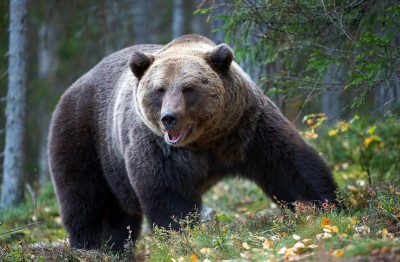
Order: Carnivora
Family: Ursidae
Genus: Ursidae
Description. Male bears of the most common regional populations (inhabiting the Far East, Kamchatka, and Alaska) grow up to 2.55 meters long, 1.35 meter high (shoulder height), and 600 kg. Their color ranges from straw yellow to dark brown and coal black. In terms of geographic spread, there are up to seven subspecies of brown bear.
Status. Common.
Habitat and Behavior. Brown bears inhabit lowland and mountain forests of Eurasia and North America. They occupy forests, mountain forests and forest tundra regions. Sometimes they also can be found in tundra and sea coasts. Brown bears lead a solitary life, mostly settled; however, in mountain regions they can move regularly in search of food. Bears eat mostly plants; in the Far East they feed on spawning salmons. Sometimes they can attack ungulates. Brown bears spend winters in their lairs.
Brown bears are mostly nocturnal, also active in twilight hours, but sometimes in daylight as well. They eat plants, larvae, ants, sometimes rodents and their reserves, and scavenge on carrion. Some specimen, most often males in the northern regions, hunt ungulates stalking or sneaking up on them. An adult bear can break a horse’s or a moose’s spine with a single paw blow. Bears cover their prey or discovered carrion with brushwood and remains in the vicinity until finishes it. If a bear is not very hungry, it can wait for a couple of days until the meat softens up. The Far East bears catch spawning salmons in summer and autumn. Sometimes one can find 10 to 30 bears at the same time along the spawning rivers. When they can, brown bears hunt sea otters and seals at coastal haulouts, and may even go out on ice to catch ringed seals. In regions with hot springs, bears like to take their ‘healing baths’, especially early in spring.
Most mythologies in Eurasia and North America consider bears a link between the world of men and the world of nature. Prehistoric hunters viewed it mandatory to perform rituals over the corpse of a bear they killed to ask the animal’s spirit for forgiveness. Indigenous populations of Far North and Far East still perform such rituals even in the modern times.
Animal Life of Russia, encyclopedia prepared by V.L. Dinets, E.V Rothschild, 1998.
***
“Most Western European countries have hunted their brown bears to near extinction; and now accidental specimen who wander into those territories are rigorously protected. Here in the Far East, these bears still live in abundance. They are careful, so it is a rare occasion for people to catch a glimpse of them. Their traces in taiga, however, are easy to discover even for those with no hunting skills. Still, no one is entirely safe from accidents of meeting brown bears ‘face to face’: not the beginner hunters, not the tourists, not the people who go berry- or mushroom-picking.”
Extract taken from: Sergei Kucherenko, Animals At Their Home.