

Dolly Varden Trout (lat. Salvelinus malma)
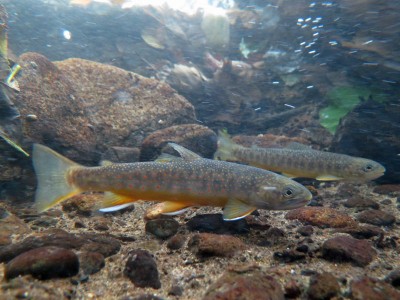
Order: Salmoniformes
Family: Salmonidae
Genus: Salvelinus
An anadromous freshwater species.
Description. This is an average sized char with sharp head and tall body flattened on the sides. There are numerous small white or yellowish round spots on the sides and back. Males display sharp changes during the mating season. The mating colors are: red lips, bright red edge of the tail fin, white beams along the edges of the fins; sides are greenish blue, the belly is red.
The Northern and the Southern Dolly Vardens are typically distinguished as subspecies. The Northern one grows up to 1.2 m long and weighs up to 12 kg; they live around 15 years. The Southern Dolly Vardens are smaller: only 75 cm long, and 3.8 kg; they live up to 10 years.
Status. Abundant species. They are an object of traditional local fish trade and recreational fishing.
Habitat and Behavior. Dolly Vardens are found along the Asian Pacific coast from the Bering Strait to Korea, and along the North American coast from Alaska to California.
They are mostly anadromous; however, they can form residential groups (in rivers and creeks).
They drift to the sea in spring – early summer; they come back to rivers in the end of summer and early autumn. The anadromous lifestyle is mostly typical for the Northern Dolly Varden; their sea migration can extend from several hundred to 1.6 thousand kilometers. The residential groups are rare and mostly consist of dwarf males.
The Southern Dolly Vardens do not stray far from the coastal waters around the river estuaries; creek and river forms are known and include equal percentage of both sexes.
The young fish of the northern variety live in rivers until drifting into the sea for 2 to 4 years on average, the southern ones – for 4 to 6 years. The food is practically the same for the entire habitat: the Dolly Vardens usually feed on water insect larvae, and salmon and other species’ roe; river and downstream migrant fish eat young migrant salmons and fry of other species. When at sea chars prefer zooplankton, sometimes young fish. They mature from 3 to 7 years, often at the age of 4 to 6.
Both subspecies breed in the end of summer, in early autumn. They build small nests in the fine pebbles of cold strong currents and dig their roe down after spawning. Most of the Dolly Vardens spawn yearly; only a small number of chars (usually, males) miss a year. After spawning only a small number of fish dies, others may breed 5 or 6 times, but mostly once or twice.
Their habitat is extensive. It includes the northern regions of the Pacific south of the Bering Strait: along the Asian coast – to North Korea and Japan, and along the North America coast – to California. This species is also found in the Arctic seas: westward to Kolyma, and eastward to the Mackenzie river. The northern border of the habitat of the Southern Dolly Varden goes along the mainland coastline of the Sea of Okhotsk between the Ulbeya river and the Shantar Islands, and along the First Kuril Strait between Kamchatka and Shumshu.
A poorly studied and rare char form inhabiting the Kamchatka river basin called stone char has the status of a rare species; however, it is not listed in the latest version of the Red list of endangered species of Russia.
* * *
“Malma – the Dolly Varden trout, even though it is not a trout, – inhabits the northern Pacific regions. In autumn their small groups only come to small mountain rivers flowing into the Amur lagoon… What a pity it is that we do not tell stories of the peculiar beauty of this fish, its habits and unsolved mysteries of its life!”
Extract is taken from a book on the Amur fish fauna: Fish At Its Home by Sergei Kucherenko.