

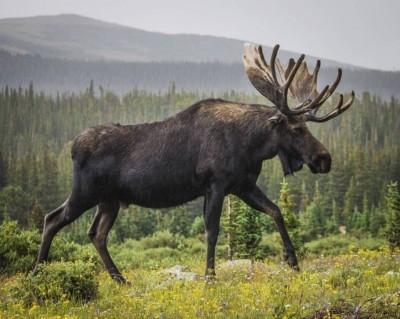
Moose, or elk (lat. Alces alces)
Moose is the largest species of deer and the only species within its genus. People in the Far East call them ‘sokhaty’.
Description. Moose grow up to 3 m long, and up to 2.3 m shoulder high. They can weigh up to 570 kg. They have heavy massive bodies and large heads with a fleshy upper lip. Moose have a fold of skin under the chin called a dewlap, or bell. It is more developed for males. Male moose (bulls) have rake-shaped or spade-shaped antlers, which they shed in December and grow new ones by August. In winters moose are coffee brown, but become darker in summers. Legs are usually white.
Status. Common. Game animals.
Habitat and Behavior. Moose inhabit the woodlands of Eurasia and North America. They live in forests, but sometimes spread to forest tundra and wooded steppe regions. Moose prefer wet swampy lands. They hide from the blood-sucking insects in the water, where they can stay for hours only raising their heads above the surface. They tend to be solitary or to form groups of 3 to 5 individuals. Moose feed on grassy plants; in summers – on aquatic and semiaquatic plants, sprouts and sprigs of trees and bushes, and in winters – on fir needles and bark.
Moose are active at all times of the day, but prefers to feed before dawn and after sunset (or at night, in highly-populated areas). They are solitary, or form small groups of up to 10 individuals in winter. Moose are much more mobile in summer. Bulls shed their antlers early in winter and start growing new ones in spring. By August the new antlers become completely free of skin. Their long legs and broad hooves that splay under load allow moose to move through swamps and snow. Nevertheless, by the end of winter they cease moving around almost completely only covering about a kilometer per day. At that time they often gather in specific camps in the forest, where they create a dense net of paths. When sensing danger, a moose uses its incredible physical strength to break through the snow to the nearest path and leave. V.L. Dinets, E.V Rothschild, Russian Nature Encyclopedia, —Moscow, ABF, 1998.
“The word ‘sokhaty’ is rarely used in Russia, we call them ‘los’ (‘moose). However, in Siberia the common folk won’t understand you if you use that word. They will stare at you wide-eyed and rack their brains as to what you are referring to. But you only need to mention ‘sokhaty’ – and they’ll know that very instant what you mean. Other locals, the Tungus, call moose ‘kondagay’. One presumes that the word ‘sokhaty’ is derived from a name we have for a plow – ‘sokha’, since the moose bulls’ antlers resemble that instrument. But the Siberians, on the contrary, use that resemblance the other way around calling the plow a ‘rogalyukha’ (from ‘roga’, which means ‘antlers’), similarly to calling a fork in a river formed at the top of the ravine at a sharp angle a ‘rassoshina’ (from ‘sokha’). I truly do not know where the word ‘los’ comes from, and I will not guess, lest people decide I’m a philosopher. Probably, it is due to the fact that moose having a glossy smooth short and harsh fur can be said to ‘losnitsya’ (shine).”Extract taken from: Aleksandr Cherkasov, Eastern Siberian Hunter’s Notes.