

Lenok (lat. Brachymystax lenok)
Order: Salmoniformes
Family: Salmonidae
Genus: Brachymystax
Lenoks are freshwater fish and the only species within its genus. It is very common and can be found all over Siberia and the Far East.
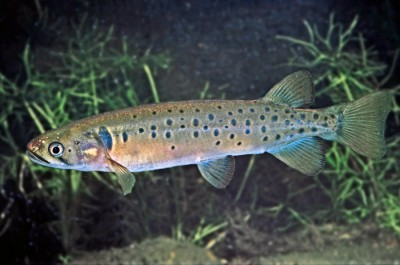
Description. Lenoks grow to be around 70 cm long and weigh up to 8 kg (usually, 3 kg). Unlike other salmons, they have small mouths. They are dark brown with a golden sheer. Their sides, dorsal and tail fins are covered with small dark round spots. When spawning, red spot also appear on the sides. There are two forms, sharp-snouted and blunt-snouted lenoks, sometimes being treated as separate species.
Status. Lenoks are an object of recreational fishing (except for the Ob River where the population is endangered).
Habitat and Behavior. Lenoks live in rivers and mountain lakes of Siberia and the Far East, also in western regions of Korea. Young fish feed on bottom invertebrates, other fish, roe and salmon fry. Lenoks spawn from May to July, and often die aster spawning.
Lenoks prefer the strong cold rivers, mostly the upstream areas. They keep in small pods, but the large specimens can be solitary. They grow slowly. There are records of lenoks of up to 8 kg and 1 meter long being caught.
They resemble whitefishes in shape. They have long sturdy bodies, small mouths with small sharp teeth, and small tightly placed scales. The colors depend on the environment. Lenoks living at rifts are more silvery in shade.
Lenoks reach sexual maturity at the age of five to eight years, growing 38 cm long and weighing 600 to 800 grams. They lay 3 to 7 thousand eggs. Females usually mature a year after the males do. They spawn from May to June at the depth of 0.5 to 1.5 meters. The roe is 4 to 4.5 mm in diameter and weigh 50 to 60 mg.
As Sergei Kucherenko says in Fish At Its Home («Рыбы у себя дома»), “lenoks have juicy tasty and fatty flesh. It is better when fresh, salted or smoked. Well salted roe can be compared with chum salmon roe. Lenoks’ liver has 14 to 15 percent of oil that can be used as a medicine. The skin is used for making durable waterproof shoes… There is a reason as to why spinners and anglers often agree to trade a couple of pikes of the same weight for one lenok.”
***
“Lenoks are everywhere in Siberia. They are like trout for us, just as tasty and beautiful. Dark grey backs with golden and crimson tint. Heads, sides and fins covered with black round specks. Copper red spots all over the silvery body. Trout would turn green with envy! Lenoks grow slowly and breed only when reaching the age of five. They do not lay plenty of eggs: just four to seven thousand. They rarely grow heavier than 5 kilos. Unlike any other salmon, lenoks have small weak teeth and small almost lateral mouths with protruding upper lip. Before spawning they ‘fire up’ growing red; only the edge of their paired and anal fins turn white for some reason.”
Extract taken from: Petr Sigunov, Jahangir Jewels.
***
“Those were the first days of June; lenoks have just spawned and have not yet ‘taken off’ their mating ‘dresses’… That was the night when I managed to examine this fish closely in all its glory. It will never be as dear to me as a carp; however, I found a place for it in my heart.
Indeed, how could I not admire its sturdy body, its vigor and the beauty of its leopard-like skin glistening with flowing velvet sparkles, and its clear and see-through fins! And how slim it is, how smooth, what ideal proportions it has for a fish! And how well it hides against the river bed with all its speckles!
[…]
“Fishers often tell stories of trolling ‘brightly colored ravenous predatory lenoks’, or bait fishing at the very least. However, they are not so ravenous as, let’s say, pikes or taimens. Lenoks are almost omnivorous, safe for the plant food, probably, which is not for them. They have relatively small mouths and weak teeth (and not many of them). Small fishes, mostly gobies, gudgeons, minnows, and bitterlings, but rarely also graylings’, asps’, steeds’ and rubbots’ fry, form its regimen. In winter lenoks feed mostly on sharpbellies and smelts; but in spring their diets change to various invertebrates: caddis and day fly larvae, sometimes even those of stone flies and dragonflies. Sometimes they also get chirinomids, roundworms and small mollusks… As Amur ichthyologists note, when it is warm, the fish only takes some 18 percent of this ‘ferocious predator’s’ diet.”
Extract taken from: Sergei Kucherenko, Fish At Its Home.