

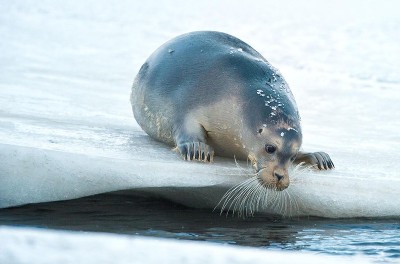
Bearded Seal (lat. Erignathus barbatus)
Bearded seals are the largest species of the Far Eastern true seals. They are less timid than other species.
Description. Bearded seals are 180 to 240 cm long; they weigh 230 to 320 kg. They have massive bodies, almost evenly thick; so when the animals lie down, they resemble thick logs from a distance. They have relatively small heads with long snouts and almost no distinct necks. They have thick long whiskers. Their front flippers are disproportionally short, almost rectangular, with long strong claws. They are uniformly colored, with brownish grey backs and sometimes 2 or 3 blurred white spots. Their bellies are light grey; their heads and necks may sometimes have a rusty brown tint to them.
Pups are born 130 cm long and weigh 30 kg. They have brown fur that turns ash grey in 2 to 3 weeks; young seals retain a dark T-shaped spot on their noses and above their eyes.
Status. Abundant species, object of hunting.
Habitat and Behavior. Bearded seals inhabit all Arctic seas, the Bering Sea and the Sea of Okhotsk.
They prefer the shelf waters; however, they can drift to the deeper regions on ice. They often come to tidal river mouths (estuaries that get flooded) and lagoons (shallow gulfs and bays), sometimes going upstream for tens of kilometers. At sea they tend to lead solitary lives. They give birth from March to May on open ice. In summer they come to the shores to rest. The haul-outs are usually located on sand or pebble islets that dry up at low tides, also on sandspits, capes and at river estuaries. When swimming, they raise their heads and front areas of their backs above water. When diving, they usually show backs and, often, back flippers. Bearded seals are less shy and timid than other true seals; when disturbed, they remain on the surface longer and allow boats closer. Bearded seals feed on bottom fauna: crabs, shrimps, worms, shellfish, sometimes fish.
Similar Species. Other than the color peculiarities, constitution and whiskers thickness, other true seals are relatively slim; their spindle-like bodies have distinct necks. They are more active, mobile and careful around humans. Other similar species include the Steller sea lion, northern fur seal and walrus.
True seals (lat. Phocidae) can be of various sizes, from really small to rather big. They have streamlined spindle-shaped bodied and rounded heads with no ear flaps. They have short but distinct tails. Their flippers are short and fully covered with fur; they also have well-developed claws. The front flippers are positioned closer to the front end of the body; the back ones are extended backwards and cannot be bent under the body. They have short rough overhair with no distinct fluff. Ringed seals show little to no sexual dimorphism as to their sizes. Most of the Far Eastern subspecies breed on ice; their pups are born in embryotic cover of long soft thick white fur. There are 18 species of true seals in the world; 10 of them can be found in Russia, 5 – in the Far East. s