

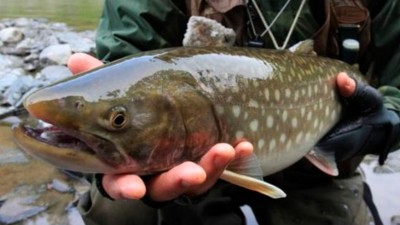
Kunja (lat. Salvelinus leucomaenis)
An anadromous species. A large species of the Far Eastern chars.
Description. Whitespotted char grow to be over 1 m long and weigh up to 11 kg; however, specimens of 30 to 60 cm and 0.5 to 3 kg are more common. They have massive heads and big menacing mouths. They can be identified by clear large light spots along their bodies. They have dark backs, light silvery bellies and brown sides.
Status. Whitespotted chars are scarce. They are an object of recreational and game fishing.
Habitat and Behavior. Whitespotted chars inhabit the basins of the Bering Sea, the Sea of Okhotsk and the Sea of Japan. They are predators feeding both in rivers and out at sea. They spend the majority of their lifespan at sea in the coastal waters. They mainly feed on small fish, freshwater shrimp and larvae of water insects. The spawn several times, mostly in August and September. Sometimes they also form residential groups (in rivers and lakes).
Anadromous whitespotted chars spend their lives at sea, mostly in coastal waters. They come to rivers and lakes to spawn. They lay eggs from June to September depending on the region. They do not die after spawning, but stay in fresh water until spring, and then migrate to the estuary areas. Whitespotted chars reach maturity in their third or fourth year when growing up to 23 (even up to 40) cm. Young chars drift to the sea before reaching maturity. When out at sea they usually stay close to the river estuaries, lagoons and lakes connected to the sea.
Adult chars are active predators feeding on small fish (smelts, other char species or sand lances), including young salmons that only drift out to the sea after spawning; thus, whitespotted chars may negatively affect the salmon population.
Residential groups (in rivers and lakes) can be found in the northern regions of the habitat, in the Sea of Okhotsk, but they are rare. In southern regions lake-lagoon populations also exist along with river and creek ones.
“If you do not have a bait, it is easy to find. You simply need a beetle, a fly, some bread crumbs or even brightly colored fabric. Chars do not believe their eyes, they need to taste whatever they see. After catching one, you will not run out of bait anymore. Cut the caught one in small pieces and use that. It is astounding sometimes how greedy and swift this fish is; they attack even those lures that are bigger than them.
Whitespotted char is a semianadromous species inhabiting the coastal sea waters, river estuaries and estuary regions. Small ones, up to 30 cm, may constantly live in lakes, rivers and creeks. They can grow up to 1 m. In the Kuril Islands in winter we used to catch 1 meter long chars of up to 6 kg using ‘baikal’-type lure. However, we usually catch chars of 1 to 3 kg, not to mention the small ones.
The whitespotted chars are known for the light-colored beams along their pectoral, pelvic, and anal fins. Their dark grey roundish bodies are covered with round pea-sized white spots. These distinguish the whitespotted char from all other fish species found in the Sakhalin waters.
We used to catch chars all year round. The bite is always good, so it is hard to say when it may be better. It all depends on the fishers, their experience and knowledge of the chars’ habits and habitat. However, there is one ‘dead’ season: after the first ice. Then the bite decreases to almost none for some time. There is one more break in early October, when large chars start spawning. These breaks last for about a month each. In summer whitespotted chars are the easiest catch for fishers. You do not even need to look for them, they live in every river.”
V. Skurchaev, Whitespotted Char in Sakhalin.