

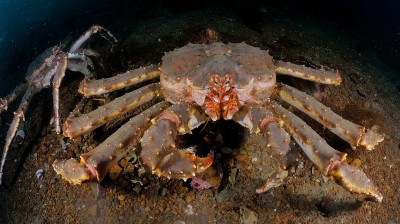
Crabs
Due to their taste, certain crab species have been a traditional object of trade for a long time. Almost from the beginning of last century the entire fleet of crab fishing boats have been catching and processing crabs. They are mostly active in the Sea of Japan, Sea of Okhotsk, Bering Sea and adjacent Pacific waters.
Crabs form a separate numerous group of decapods crustanceans, which includes over 4 thousand species inhabiting mostly the tropical salt and fresh waters, less often on land. Crabs are also abundant in the temperate waters.
The majority of crabs tend to live at the bottom. Only a small portion of tropical species are capable of swimming. In the bottom community they are consumers, on one hand, eating the bristle worms, mollusks, echinoderms, crustaceans and also carrion; and on the other serve as food themselves to fish and marine mammals.
Crabs vary in terms of sizes greatly: small crabs may have a couple millimeters long carapace (the dorsal section of the exoskeleton), while the giants are over half a meter long with leg span of three meters (like the Japanese spider crab, Macrocheira kaemferi). The usual size of the commercial species depends on the specific specie and their carapaces range from 8 to 25 cm long. Macrocheira kaemferi. Обычно же размер промысловых крабов, в зависимости от конкретного вида, составляет по ширине панциря от 8 до 25 см.
The main harvested species of the Far Eastern crabs are actually not true crabs, but king crabs (lat. Lithodidae) belonging to the Anomura family. Unlike the true crabs, king crabs only have four pairs of legs (not five), including the front one with pincers (chelae). The fifth (hinder) pair is shortened and always hidden underneath the shell. Unlike the true crabs, king crabs have asymmetrical bellies (similar to hermit crabs).
Here are the most common true crab and king crab species in the Sea of Okhotsk.
Red king crab, or Kamchatka crab (lat. Paralithodes camtschaticus)
One of the most valuable harvested marine species; they are common for the northern Pacific shelf (2 to 300 m deep) of the Sea of Japan, Sea of Okhotsk and Bering Sea, from the Karaginsky Gulf in the north to Unkovsky Gulf (South Korea) in the south. It also can be found along the Pacific coast of North America from the Norton Island to British Columbia; and in 1960–1979 it was successfully introduced to the Barents Sea. Red king crabs live in water of -1.6° to +18°С with salt content of 28–35‰.
Red king crabs are one of the largest king crab species with the adult males having leg span of up to 150 cm and shell width of over 26 cm (usually 13 to 16 cm). Females are much smaller with shell width of up to 20 cm (usually 10 to 12 cm). The red king crabs live up to 25 years. They reach sexual maturity at the age of 8 to 10 years.
Red king crabs feed on bottom invertebrates: bivalve mollusks, crustaceans and bristle worms mostly; also gastropods, sea squirts, hydrozoans and echinoderms to a lesser extent, sometimes even sponges, fish, moss animals, algae, etc.
The main harvesting area for the red king crab in the Russian Far East is the western Kamchatka shelf, where the biggest red king crab population is found that provides for 90% of the entire harvest (20 to 45 thousand in the late 90-s). Lately the harvested males have become most numerous in the Ozernovsky and Kikhchiksky regions (south of the 54°N latitude) – over 400 individuals can be caught in an hour.
The total number of harvested males in the Ayano-Shantar region reaches about 45 million specimens; the crabs are mainly grouped in the Ayan region at the depth of 30 to 50 m, and the population decreases gradually to the north.
The muscles of the extremities is usually used in canned food, and the bodies are used for fine offal and fertilizers.
The red king crab is a valuable commercial harvesting species and a delicacy. It has tasty and rich meat used for canned products. It is known all over the world; however, it is most popular in Japan. Japan, the United States, Canada and Russia are leading crab harvesting countries.
The red king crab is also an object of poaching. Its trade has become extremely criminalized in late 20th – early 21st century.
Golden king crab (lat. Lithodes aequispina)
Golden king crabs are common all the way from the British Columbia to Japan. They mostly live in cool (but above zero) water: adults keep to the areas of +1.0 to 2.0°С, while the young ones can live at +0.2° to +1.0°С. Young crabs form tight groups reaching thousands of individuals.
The males can have 24 cm wide carapace and can weigh 6.7 kg; the females reach the width of 18.5 cm and weigh 3 kg.
Golden king crabs do not go on distinct seasonal migrations due to the fact the temperature of the bottom layers along the continental rise where they live almost does not fluctuate.
Blue king crab (lat. Paralithodes platypus)
Blue king crabs are common for the Far Eastern seas from the Chukchi Sea to the Peter the Great Gulf and Hokkaido at the depth of 15 to 500 m (usually to 200 or 250 m).
Males can have over 20 cm wide carapace; females are slightly smaller. Similar to the red king crab, the blue king crabs migrate for spawning to the coastal areas in April. They return to the deep for winter.
Blue king crabs feed mostly on the non-mobile benthos (mollusks, sea urchins, bristle worms, brittle stars, starfish and sea anemones), even though sometimes they can also eat crustaceans.
Blue king crabs are rather rare, but stable species, even though slightly inclined toward decrease. Snow crab (lat. Chionoecetes opilio) Snow crabs are among the most common and in some regions (especially, the shelf and upper continental rise areas of all Far Eastern seas) even abundant species. They can be found from Korea to Hokkaido, and from the Bering Strait to British Columbia. They live at a temperature range of – 1.8° to +7.0°C, which makes it one of the most cold-resistant crab species. Snow crabs do not migrate for spawning to long distances. In the western Sea of Okhotsk they can be found 18 to 600 m deep. The widest recorded carapace for the crabs inhabiting the Sea of Okhotsk was 16.4 cm. Young crabs prefer silty gravel soils, whereas the adults can be found deeper on silt and silty sand substrates. The species has 2 migration types: short-distance (local) and long-distance (true migrations). Snow crabs travel locally for several hours to find food within their usual territory; they are mostly nocturnal. Long-distance migrations can last for days and even longer. Some data has it the males migrate 25 to 40 kilometers, not more. Females tend not to migrate at all. *** “Behind the cliff, where small fish transparent as a glass dance in greenish blue water, a king crab clad in menacing armor freezes in its place disturbed by the divers. It is leaning forward at 45° angle extending its claws in a usual protective stance for animals of its kind. It is one of the biggest known crustanceans with a 1 meter leg span (its cousin, the Japanese spider crab, has a leg span of up to 3 meters). However, the armored legs, the dorsal ‘shield’ and rather impressive-looking claws do not save it from being one of the sea otters’ favorite dishes. Humans also find them delicious.” Extract taken from*: Jacques Yves Cousteau, Salmon, Beavers and Otters.