

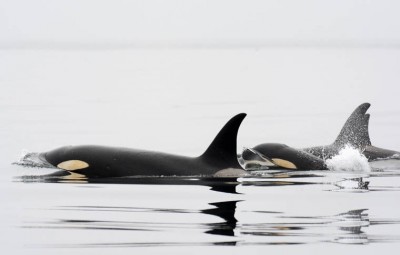
Killer Whale, or Orca (lat. Orcinus orca)
The largest dolphin and the only true predator among the cetaceans. The Russian name (‘косатка’) presumably derives from the Russian word for ‘braid’ (‘коса’) due to the fact that the males’ dorsal fins might be seen as resembling that shape.
Description. Killer whales are 5.5 to 10 m long, and weigh 2.6 to 9 tons. The males are significantly larger than the females, who grow no more than 8 m. Killer whales have massive robust and relatively short bodies. They have conic heads with no discernible beak. The pectoral fins are broad and oval in shape. The large black dorsal fin is species-specific: the males have triangular dorsal fins or up to 2 m long, whereas the females and the younglings have shorter crescent-shaped ones. Killer whales have black backs and sides with a characteristic white spot above and behind the eye, and a grey ‘saddle’ behind the dorsal fin. They also have a sharp white spot on their chests.
Status. Common.
Habitat and Behavior. Orcas can be found both in coastal waters and in the open sea. Sometimes they may stay solitary, but usually then form family groups of 2 to 12 individuals of various sizes and ages. Different families can form pods of over 100 individuals. Orcas’ blows are wide and clearly visible, up to 3 m high.
Similar Species. When observed from a distance, single males and young orcas may be mistaken for a Risso’s dolphin or a false killer whale. Risso’s dolphins are smaller, they have grey heads and backs, numerous scars along the body, sharply cut heads and long crescent-shaped pectoral fins.
All the stories about killer whales attacking boats are easily explained by the predators’ curiosity (a strong orientating reflex) that resembles an attack when observed.
***
“The orcas’ grim fame is centuries-old. ‘Sea wolf’, ‘wolf in a whale skin’, ‘bandit’, ‘killer whale’ – these describe orcas in various languages. Carl Linnaeus himself called them torturers and tyrants among whales. It is true, their entire appearance screams ‘predator’. They are the largest dolphins: newborn orcas reach 2.75 m in length, females are 7 m long, and males are 10 m. The largest male was found on June 3, 1927 in the Kandalaksha Gulf of the White Sea in a group of 30 orcas. His skeleton is on display at the Leningrad Zoological Institute.
Orcas are easily distinguished by their huge dorsal fin, which resembles a braid from behind. Adult males have their dorsal fins of almost the height of a human; whereas the females’ fins are half that size. Orcas have bright white oval spots on their temples, on each side of their blunt heads. There are also white saddles behind the dorsal fins (but only for males). All the bright spots and marks supposedly help orcas find their correct place in the formation without bumping into each other when moving fast (they can reach the speed of 55 km/h). There is also another use for those marks: they ‘break’ the overall silhouette thus helping with the camouflage.
Orcas can be found in many regions from the borderline Arctic seas to the Antarctic. They migrate irregularly. In temperate and moderately cold waters they gather in areas rich with food, especially around the active trawler ships. They are cosmopolitan; however, they do not inhabit the Black Sea, even though they do come to the big fresh rivers’ estuaries sometimes, going upstream for tens of kilometers and staying there for weeks.”
Extract taken from: Avenir Tomilin, In the Whales’ and Dolphins’ World.