

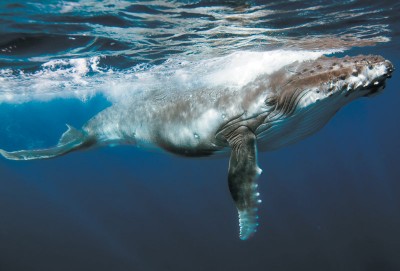
Humpback Whale (lat. Megaptera novaeangliae)
Humpbacks are the only modern species in the genus. They received their name either after the shape of their dorsal fins, or due their practice of bending their backs when diving underwater. They have another name in Russian, which translates as ‘long-handed rorqual’ (“длиннорукий полосатик”) due to the fact their pectoral fins are very long.
Description. Humpbacks are typically 11 to 16 m long and 25 to 30 tons. They have short and relatively stout sturdy bodies and rather large flattened heads with numerous knobs. They have 12 to 36 wide ventral grooves. Their mammary slits are covered by 270 to 400 pairs of wide ashy black baleen plates up to 85 cm high with hard short fringe. Their blowholes are paired and V-shaped. The dorsal fins are located closer to the posterior third of the body; it is low, thick and hump-like, with a cutout-like tear along the back part and a shallow dent at the front. The pectoral fins are incredibly long (up to ¾ of the body length) and narrow, with a wavy knobbly front edge. The tail fin is broad, with a barbed back edge curved inwards and a considerable dent in the middle. Humpbacks are usually black; however, the throat and ventral areas may be marked or pure white. The bottom side of the pectoral and tail fins is usually partially or completely white.
Status. Rare. Humpbacks are listed in the Red List of endangered species of Russia.
Habitat and Behavior. Humpbacks inhabit the shallow coastal shelf waters; however, during migration season they can be found far in the open sea. Usually they stay solitary or form small groups of up to 3 individuals. When deep diving, they bend their backs and tail stems sharply demonstrating their tail flukes. Humpbacks may spend up to 20 minutes underwater, but rarely more than that. When breaching their blows and dorsal fins are visible at the same time. The blows are rather wide and up to 3 m high. Humpbacks breach more often than other large whales; they flap their pectoral fins in the air on the water or, and stick their heads or tails up in the air. Sometimes they come near to boats.
Similar Species. From a distance, one can easily mistake other rorquals for the humpbacks; mostly, the blue whale who may have a similar shaped dorsal fin. However, the blue whales’ dorsal fins are relatively shorter and further removed towards the tail, so it may not be usually observed at the same time as the blow. Also, blue whales raise their tail flukes above the surface only a little and rarely.
Humpbacks dive in almost vertically, steeply and bending themselves sharply, then raising their tails high up. They breach more often than other whales and then crash against the surface with a deafening splash. They are relatively slow swimmers.
In summers, they can be found in the Chukchi Sea, but leave that area for the winter season and breading to California basin. Whales that inhabit the waters of Kamchatka and the Commander Islands migrate to the south of Japan, or to the Barents Sea. When they come across a school of small-sized fish, the humpbacks spiral around it corralling it in a small area by blowing out bubbles of air (it is called bubble net feeding), and then lunge at it upwards swallowing the entire school. They filter out large plankton floating on their sides. Humpbacks usually move around in pairs or in groups of 3 individuals.
During the breeding season the males spend hours ‘singing’ – making low-pitched long sounds resembling wind band music. Each male has his own ‘repertoire’ that he repeats in variations each year. It is probable that, like singing birds, the humpbacks learn separate ‘songs’ from each other.
V.L. Dinets, E.V Rothschild, Russian Nature Encyclopedia, —Moscow, ABF, 1998.
* * *
“In 1937 we were investigating the circumstances of whales dying along the Kamchatka coast. We established that the whales dry up due to varying water levels (strong tides, storms, high seas) and highly washable beds with barriers, submerged sandspits, sandbanks, etc. All it takes for a whale to come there with the high tide and linger for a moment – and then the waves create a barrier bringing in silt and sand; and the whale will be incapable of crossing it. Back in 19th century A.F. Middendorf called such places in the Sea of Okhotsk (Uda and Ala estuaries) the ‘whale traps’. Areas that are dangerous for the whales can be found along the coastlines of every continent. However, all of this does not provide us with an answer to the most important question: what is it that makes cetaceans who are ‘equipped’ with perfect sonars lose their way, which eventually leads them to dry up, and what is the basic reason for the catastrophes that happen to them?”
Extract taken from: Avenir Tomilin, In the Whales’ and Dolphins’ World.
***
“Humpbacks are distinguished not only by their long white fins and passion for singing, but also the specific migration type. From January to March they travel to the Caribbean, to Puerto Rico, Bahamas and Virgin Islands regions. From April to June they are found along the coasts of South and North Carolina, to the west of Gulfstream. They spend some time in shallow waters around the Bermudas, where we were lucky to film them and record their magnificent music. After resting in that region they migrate to the north-east, towards Iceland and Norway.
Consistent routes resulted in the humpbacks suffering greatly from whaling, especially in Newfoundland, along the southern coast of Labrador, and in New Zealand and Australia.
Humpbacks specific behavior also facilitates whale hunting. They prefer coastal waters, they are slow swimmers, and they do not even attempt fleeing from their pursuers when they feed or mate. We witnessed it ourselves in the Bermudas.
Up until recently humpbacks were ruthlessly chased around using helicopters, sonars, and harpoon guns; and their population quickly decreased. Whalers also used pneumatic pumps: dead humpbacks drown, so the whalers filled the corpses with compressed air. What animal can withstand and fight such a sophisticated attack?.. If the humpbacks survive, it will only be due to the fact that whaling, while sentencing certain species to extinction, signs its own death sentence as well.”
Extract taken from*: Jacques Yves Cousteau, The Whale: Mighty Monarch of the Sea.