

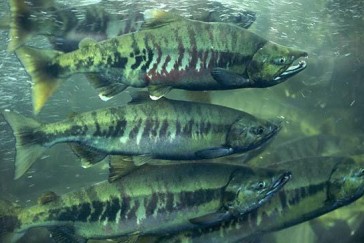
Chum Salmon (lat. Oncorhynchus keta)
Anadromous game fish, chum salmons rank the second abundant species after the pink salmon among the Pacific salmons.
Description. Chum salmons are larger and stronger than the pink salmon. Their scale is much bigger. When living in sea waters, they are silvery (silverbrite salmon) and uniformly colored, with no spots on the body or fins. In rivers they become brownish yellow with dark purple or crimson stripes. By the time of spawning chum salmons become black.
They form two anadromous groups: a summer one (they migrate and spawn from June to September) and an autumn one (from October to November). The summer group individuals grow to be up to 80 cm long, the autumn ones – up to 1 m long.
Status. Object of fishery and culture.
Habitat and Behavior. The chum salmon have the widest habitat of all Pacific salmons. It includes the Arctic and the Pacific Oceans. Chum salmons spawn in rivers from the Lena estuary all the way down to Korea and Hokkaido, and also along the American Pacific coast from Alaska to California. Young salmons feed on invertebrates, and mature ones – on sea fish. Chum salmons along with pink salmons can be found in the Sakhalin rivers.
Chum salmons cover from 20 or 30 km upstream in Kamchatka and Sakhalin to 2000 km in the Amur basin for spawning. It has been noticed that the summer salmons tend to spawn in the northern area of the habitat, while the autumn ones prefer the southern regions.
The chum salmon is also called keta salmon, and ‘keta’ (кета) in Russian, which is derived from Nanaj word keta meaning ‘fish’. In Russian, the stress falling on the first syllable is recorded as the correct one; however, the last stressed syllable is also permitted. The latter version is common for the Far Eastern sailors’ speech.
* * *
“How numerous were the losses suffered hourly by the chum salmons! However, despite everything, the strongest and the luckiest ones managed to break through to the spawning grounds. Two or three out of every ten. And they paid a heavy price for that breakthrough. Elegant sea beauties became almost ugly and skeleton-like. They lost half of their weight, 97 to 98 percent of their bodily fat and over half of the proteins as well… Famous for its juiciness, richness and taste, red salmon flesh turned to a white slushy mass. And as for the portrait, it turned completely unrecognizable: from beautiful majestic silvery profiles they became black ugly monsters with vulturous crooked beaks and misshaped lower jaws, with mouths full of sporadically placed creepy teeth of different sizes…”
Extract taken from: Sergei Kucherenko, Fish At Its Home.