

Alaska Plaice (lat. Pleuronectes quadrituberculatus)
Order: Pleuronectiformes
Family: Pleuronectidae
Genus: Pleuronectes
A species of a bottom saltwater fish. Alaska plaice is the largest and most valuable flatfish.
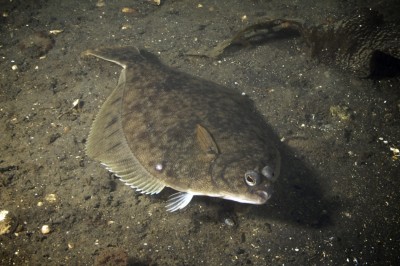
Description. Alaska plaice that inhabit the Sea of Okhotsk may reach 60 cm in length and 3 kg in weight. The average length is 34 to 47 cm though.
As all flatfish, it has flattened body; and its eyes are place on one side of it. It has mimicry abilities. Alaska plaice have 4 to 5 bone humps; so in Russian they are sometimes called ‘four-humped’. The top side is reddish brown and slightly spotted; the young fish shows marble pattern. The blind side is yellow.
Status. A valuable game fish.
Habitat and Behavior. It can be found all around the Sea of Okhotsk, including the Gulf of Sakhalin and Pritauisk region. In summer it inhabits a wide range of depth: from 20 to 400 m; however, the majority of Alaska plaice prefer the range of 40 to 100 m deep. In autumn they migrate further away from the mainland, and in winter gather in areas over 100 m deep, if the bed water temperature is above zero. They feed on shellfish and bristleworms. Learn more: Alaska plaice prefer colder or temperate waters. The biggest groups in the Sea of Okhotsk are formed along the western coast of Kamchatka, where they make the main part of the plaice catch. Altogether in Russia, there are 25 species of flatfish in the Far East waters; 9 species in the Barents and White Seas; 6 species in the Black Sea; 4 species in the Baltic Sea; and 1 species in the Arctic waters.
***
“Just in a minute I raise something black-and-white and flat to the surface. A plaice. No more than seven hundred grams, but seems line three kilos because it fights back turning its flat body almost perpendicularly and pushing away. I use the landing net and then observe it closely. A beautiful beast. It is not the grey sole that we are used to see in the fish departments of Moscow stores. This one has a deep black back with brown undertone, and a sharp white belly. Its small mouth hold the hook so strongly that I have to struggle to get it out.”Extract taken from: Andrey Anisimov, Fisherman’s Notes.