

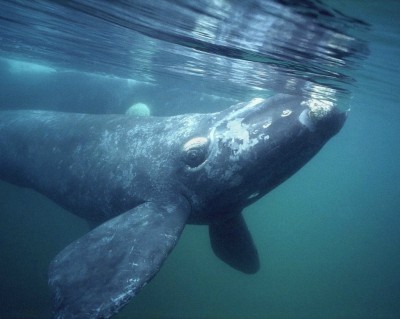
Bowhead whale, or polar whale (lat. Balaena mysticetus)
The only species of the Balaena genus.
Description. Bowheads are 14 to 18 m long and weigh 60 to 100 tons. They have large robust bodies and do not have dorsal fins. Their massive heads make for one third of the entire body length, and the heads are separated from the rest of the body by a clearly distinguishable cervical section. The mouth line is strongly bowed up and forms an even steep arch. The lower jaw is heavy, scoop-shaped, and significantly larger than the upper jaw. The mammary slits are covered by 230 to 390 pairs of long narrow black baleen plates up to 4.5 m high with soft fringe. The blowholes are paired and V-shaped. The pectoral fins are large. The tail fin is very broad, with sharp-pointed flukes and a deep dent in the middle. Bowheads have smooth uniformly black bodies with a white spot on the lower lip, chin, and, sometimes, the tail stem.
Status. Rare. Bowheads are listed in the Red List of endangered species of Russia.
Habitat and Behavior. Bowheads inhabit cold arctic waters. Sometimes they can be found in icy regions. They migrate following the movement of the ice line. They usually stay solitary or form small pods of up to 3 individuals. Bowheads are slow swimmers. They submerge for 15 to 20 minutes, and then rest on the surface for a few minutes spouting bushy doubled blows of up to 5 or 6 m high. When a bowhead is resting, its crude head and round back are visible above water separately. When diving, bowheads raise their tail flukes. They can also jump high above the surface and hit the water flat on their sides creating a loud splash.
Similar Species. Southern right whales are smaller and not so massive. They have relatively smaller heads with not so distinct cervical section; their heads are usually covered with light-colored knobs. Their mouths are more steeply bent, and their lower lip has a wavy edge. Southern right whales’ pectoral fins are broader. They do not have white pots on the lower jaw. As for gray whales, when only seen submerging, they may be identified correctly by their spotty skin, less elongated tail flukes and a characteristic ridge along the back.
Bowheads inhabit the cold waters of the Northern Hemisphere. The ‘south-most’ herd can be found in the Sea of Okhotsk (latitude 54°N). Bowheads are the only baleens who spend their entire life in arctic waters (all of the other species inhabit the southern temperate waters and only migrate into the northern ones to feed). Due to harsh environment conditions, it is difficult to observe the bowheads. In spring they migrate north, in autumn they return further south retreating from the ice. Despite their natural habitat in the arctic, they do not enjoy being surrounded by ice. Sometimes, however, they are forced to move directly through the ice breaking it as they go. In the Sea of Okhotsk one can regularly observe the bowheads around the Shantar Islands close to the shore. Bowheads feed exclusively on plankton, mostly crustaceans. Bowheads feed applying the usual method for all baleens. When feeding they move through the water with their mouths open. Some plankton crustaceans get caught in the baleen plates, and the whales lick them off with their tongues and swallow. The bowheads’ baleen plates are specifically thin, which help the whales to filter those crustaceans out that other whales cannot do due to their size.
* * *
“It is hard to describe what a person feels when they meet a whale for the first time in the water: this mighty brilliant black grey moving living cylinder. First of all, you’ll be astounded by the size. Whales are bigger than any other animal that we are used to seeing. They are bigger than anything we can imagine. You will not only be surprised, you will not believe your eyes. Your mind riots, the divers ask themselves: what is it, is it a dream or a hallucination? All of us here on Calypso feel like that. When encountered for the first time, whales terrify us. It cannot be compared to any terrestrial animal. There is also one more thing that all our divers agree on: when you look from the above, whales do not seem to move that fast. But try to touch it, catch it by its fin – then you’ll see what a miracle it is. Or a nightmare.” Extract taken from*: Jacques Yves Cousteau, The Whale: Mighty Monarch of the Sea.