

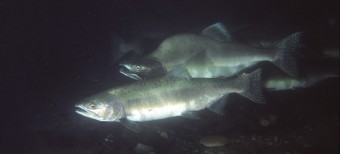
Pink (Humpback) Salmon (lat. Oncorhynchus gorbuscha)
Pink salmons are anadromous species. They are the smallest of the Pacific salmon. Their abundance (together with chum salmon it forms the major part of the salmon catch in the Pacific region) and fast growth (they reach sexual maturity in their second year of life) compensates for their small size.
Description. Pink salmons are usually 32 to 64 cm and 1.4 to 2.3 kg. When living in sea waters, they are silvery with darker spine and dark spots along the tail fin. When migrating and spawning (in rivers) they become darker. The males grow a ‘hump’, which caused the species to be also called ‘humpback salmon’. Their jaws curve, they grow large teeth. Females’ proportions do not change significantly.
Статус: Object of fishery and culture. The numbers vary clearly for odd and even years.
Habitat and Behavior. Pink salmons inhabit the northern Pacific and adjacent Arctic regions: along the American cost – all the way down to California, and along the Asian cost – to Korea. They are naturalized in the North and the Barents Sea. They gain weight in seas, but return to native rivers for spawning. They spawn once in their lifetime, and they die.
Pink salmons mature in their second year of life. They migrate massively to rivers from June to September. They spawn from August to September. They lay, in average, around 1.5 thousand eggs. The pink salmon roe is large (5.5 to 8 mm in diameter) and light orange. Pink salmons, just like other pacific salmons, lay eggs in hollows dug up in the river beds. They cover the eggs with gravel and create redds, where the roe develops. Juveniles stay in redds until spring, and then quickly go downstream to the sea. Eighteen months later they return to the same rivers they were born in as mature fish.
When living in the sea pink salmons feed and gain weight in the northern Pacific, including the Bering Sea, the Sea of Okhotsk and the Sea of Japan. At that time the salmons do not form large groups and stay in the upper layers of water. They feed on small fish, young fish and shellfish. Pink salmons spend winters with other species in the southern regions. In spring they follow the development paths of the marine life in the warming waters and migrate slowly to the northern regions. There the herds separate: young fish after feeding start returning back south when autumn comes and the water becomes colder; while mature fish begin their spawning migration.
The pink salmon catch varies periodically. Thus, in odd years they come the Primoye rivers in abundance, while in even years their numbers decrease. As for Kamchatka and Amur regions, the situation is the opposite. These periods result from the fact that the pink salmons’ lifespan is only two years: the adverse spawning conditions lead to a smaller herd returning for spawning 18 months later; it will lay less eggs, and 18 more months later the situation will repeat.
Pink salmons grow quickly and mature earlier than the other Pacific salmons – in their second year. They migrate to the rivers from June to the end of August. The salmons rarely make a mistake; they always return to the same river they were born in. This is called homing – derived from the word ‘home’. At this moment there is no clear explanation as to how they recognize their home rivers.
Experiments run on marked salmons allowed establishing that they find their streams by specific smell of the stream sediments. However, it is still unknown how they find their exact home rivers when swimming in seas. It is possible that they use some specifics of the water bodies, such as currents or bed relief.
* * *
“And finally, the spawning estuary is found; and a difficult journey to the spawning grounds begins. Salmons do not stop for strong currents, shallow barriers, rapids or waterfalls. All this time the pink salmons do not eat anything, and so they undergo significant and irreversible changes: they lose fat from their muscles, their flesh becomes limp and slushy, their liver stops producing bile, their stomach and intestines shrink, they stop producing digestive enzymes. All Pacific salmon species die right after spawning for the first and only time in their lives. A Russian scientist called their spawning migration “wandering to the death” about a hundred years ago.
After spawning, all the fish dies. The most exhausted individuals die on the spawning grounds; others are carried out by the current and die on the way to the estuary. Dead fish covers the river bed and banks. This post-spawn fish is called ‘snenka’ in the Far East. Numerous gulls, crows and various animals are drawn to the rivers to feed on it.”
Extract taken from: Ye. Vasilieva, Fishes.