

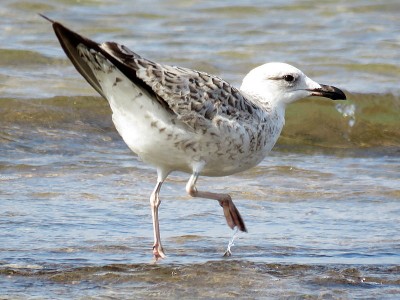
Fulmar (lat. Fulmarus glacialis)
Northern fulmars are very gullible and do not fear humans almost at all, which is the reason for its Russian name (‘глупыш’ literally means ‘silly’ in Russian).
Description. Northern fulmars grow around 47 cm long, and have a wingspan of 109 cm. They have sturdy bodies, relatively rounded heads with short necks and short thick beaks. Their plumage can be of various colors; the dark color morph is uniformly smoky grayish brown, while the light one is white and grey. There are also interim shades between these color types. The northern fulmars’ beaks are usually bluish grey with yellow top. Their legs are yellow, greenish or of natural skin color. The colors do not change due to seasons or age. Different habitats have different ratios of color morphs.
Status. Northern fulmars are abundant nesting species. In winter they can be found in ice-free regions of the Bering Sea and the Sea of Okhotsk, as well as in the Pacific region of Kamchatka and the Kurils. Small amount of northern fulmars also spend winters in the Sea of Japan.
Habitat and Behavior. Northern fulmars nest in cliffs along the sea cost, at the ledges and grassy slopes, also on flat islet tops. These birds can be found everywhere at sea. They form large feeding groups around fishing trawlers.
Similar Species. All other dark-colored Procellariidae have slimmer bodies with relatively small heads and longer thinner beaks. Larus seagulls may be mistaken for the light-colored northern fulmars; however the seagulls flap their wings in a more fluent and smooth way.
Northern fulmars feed from the surface. Their diet is rather diverse. Mostly, they eat various invertebrates, macroplancton, cuttlefish, and pelagic fish. Fishing trade refuse plays an important role in their diet as well. Hundreds of fulmars follow fishing trawlers around, especially in winter.
This species is rather abundant. It is believed that there are around 3 million northern fulmars in the Atlantic Ocean, and around 4 million – in the Pacific. They nest in colonies of hundreds or thousands; however, they also can choose to settle as small groups among kittiwakes and murres. Sometimes their nests can be found at the very bottom of the cliffs, and sometimes – on top of them. In the Franz Josef Land they nest as high as 120 m.
Unlike other petrels, the northern fulmars do not hide their nests. They make those in grassy hollows on the ground, and sometimes on bare cliffs, even on ice.
Fulmars lay one egg at a time. The eggs are dirty white with reddish brownish spots. Both parents are involved in incubation process taking turns of 3 to 4 days each. The nesting bird does not eat while staying in the nest. The egg hatches in 55 to 60 days, and the parents feed the chick once a day. The chicks start swimming 48 to 50 days after hatching. In the Novaya Zemlya Archipelago it usually happens around mid-August. As soon as the younglings start flying, the fulmars switch to vagrant lifestyle leaving their nests.
Unlike many other tubenoses, fulmars do not demonstrate domesticity by preferring certain constant nesting areas; they often change their nesting habitats. The fulmars are abundant species, and in may regions the local people and fishermen both preserve the eggs and hunt the birds. Feathers are also utilized. Fulmars can also be seen as indicators of rich waters.
Encyclopedia. 2009.
* * *
“On separate sections of the cliff-face the fulmars were nesting, with their dark-grey backs and tails and their white heads and breasts. There is something curiously pigeon-like about them, a look that is enhanced by their tubular nostrils. Although they are placid, even shy-looking birds, fulmars know how to protect their young. Should you venture too close to the nest, the parent birds open their beaks wide and eject a disgustingly smelly, sticky fluid from their mouths, and their accuracy is extraordinary.”
Extract taken from: Gerald Durrell, How to Shoot an Amateur Naturalist.