

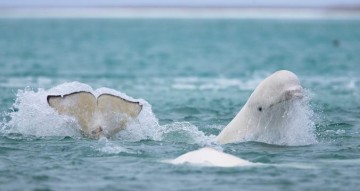
Beluga Whale (lat. Delphinapterus leucas)
The only member of the genus Delphinapterus.
Description. Three to five meters long, the beluga whales weigh from 0.4 to 1.5 tons. They have elongated bodies with relatively small heads and well-defined flexible and mobile necks. Belugas have a rounded lipid (fat) structure (‘melon’) on the forehead, which makes for a rounded head. Belugas have small, almost unnoticeable beaks. Belugas lack a dorsal fin, but sometimes have a barely discernible dorsal ridge. Pectoral fins are broad and paddle-like. Belugas are single-toned but changes with age: young whales are blue grey, then they turn light blue, and the adults are completely white.
Status. Common. Indigenous populations hunt belugas for their own needs.
Habitat and Behavior: Belugas inhabit shallow coastal waters. They often come into lagoons and river estuaries, sometimes even going upstream. In winter they live in icy waters. Belugas usually form small pods, but sometimes can get into larger groups, herds of thousands individuals. They swim calmly and slowly, usually showing only their backs when swimming close to the surface, and they do not raise their tails into the air when diving down. When moving they sometimes raise their heads above water, as if they are looking around.
Similar Species. Young and very old single-toned narwhals that resemble belugas may be correctly identified by other members of the same group.
Belugas and narwhals inhabit the cold, mostly arctic seas. They often need to break the ice above them with their backs to take a breath, so they lack dorsal fins. They often form large herds of up to 1000 animals. They are the most common cetaceans of the arctic region, except for the south-eastern part of the Barents Sea; they inhabit the Bering Sea and the Sea of Okhotsk.
Belugas often enter bays and river estuaries and go upstream looking for fish (thus, in Anadyr one can see feeding belugas from the harbor terminal in summer). Sometimes beluga groups are caught in ice traps in narrow coves and bays not being capable to reach open sea through ice patches with no leads. Belugas are very vocal producing various sounds, including a loud roar (which resulted in a Russian expression that may be translated as ‘to bellow as a beluga’).
V.L. Dinets, E.V Rothschild, Russian Nature Encyclopedia, —Moscow, ABF, 1998.
* * *
“People knew for a long time that these animals are vocal. The northern dolphin, beluga, was even also nicknamed the sea canary because it could grunt, howl, whistle, cry like a baby, shriek, and also resemble the hum of a crowd, flute notes or bird chirping. However, the cetaceans’ vocal range did not draw attention. This changed drastically during the war, when the U.S. fleet’s sound radars searching for the enemy’s submarines using hydrophones sounded the alarm in vain because of the noise the marine animals made.”
Extract taken from: Avenir Tomilin, In the Whales’ and Dolphins’ World.