

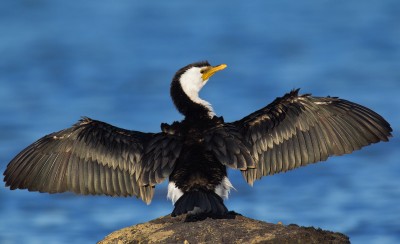
Cormorants and Shags (lat. Phalacrocorax)
Due to the fact these birds resemble ravens to some extend and have a very peculiar caw, in some countries they are called cormorants, which is a derivative of ‘sea raven’ (corvus marinus).
Description. Cormorants and shags are large birds with dark plumage, elongated bodies, long necks and tails and relatively short wings. Due to a somewhat hind position of their legs, the sitting birds hold their bodies almost vertically. Their beaks are thin, long and hooked at the tip. They have a patch of bare skin at the base of the beak, and its shape and color is species-specific.
The plumage differs depending on the season and the age of the birds. During the breeding season they grow decorative feathers that stay for the first half of the year.
Habitat and Behavior. Cormorants and shags are only capable of powered flight, they do not soar. They are excellent swimmers and divers. Under water they propel themselves with their feet. They mostly eat fish, which they catch diving. They are marine coastal birds; they nest on trees and cliffs. They are colonial nesters. Worldwide there are up to 38 species of cormorants and shags; 8 species can be found in Russia (5 in the Far East).
Five species of cormorants and shags can be found in the Far East: На Дальнем Востоке обитает 5 видов: great cormorant (lat. Phalacrocorax carbo), Japanese cormorant (lat. Phalacrocorax capillatus), double-crested cormorant (lat. Phalacrocorax auritus), pelagic cormorant (lat. Phalacrocorax pelagicus) and red-faced cormorant (lat. Phalacrocorax urile).
The pelagic cormorant is the most common one for the Sea of Okhotsk coast. The rarest species to be found is the double-crested cormorant (it is a vagrant species).
Outside of the breeding season they have a modest single-toned plumage. During the breeding season dark feathers acquire a somewhat metallic, iridescent sheen, mostly in bronze, blue and green shades. The patch of bare skin around the beak becomes more vibrant. Crests or hairlike feathers grow on the birds’ heads.
All cormorants are excellent divers. The dive from the surface and immediately go underwater. They are capable of diving as deep as 25 meters and spend over a minute submerged. They use their webbed feet to propel themselves both underwater and on the surface. They can also use their wings underwater both to move and to maneuver.
A prolonged underwater fishing would be impossible with their strong positive buoyancy, but cormorants have a high weight density. Unlike other steganopodes, their skeleton is not pneumatic, and they have no air sacks under their skin. Thus, they float low in the water as well.
They are fast flyers. However, they do not maneuver, but fly straight-lined, which is inevitable considering their heavy weight and short wingspan. When flying they extend their necks, flap their wings at high speed and, to some extent, resemble geese or ducks (especially when flying in formation). However, there is something clearly raven-like in their appearance, even if ravens move their wings slower and do not have such long necks.
Cormorants’ plumage is not waterproof. So, they need to dry it regularly on shore. They are often seen standing on cliffs, or rocks, or tree branches (much like rooks do). This is one of the reasons behind the coastal habitat for all species of cormorants.
Source: V.P. Shuntov, Difficult Job of Being an Albatross.
***
“They sat upright on the rock ledges, with their wings spread out in heraldic positions. They looked exactly like the sort of thing you find on giant gateposts that guard the driveways to ancient chateaux in France. I think the cormorant, hanging itself out to dry, as it were, looks strangely prehistoric. Perhaps pterodactyls sat in that strange position.”
Extract taken from: Gerald Durrell, How to Shoot an Amateur Naturalist.