

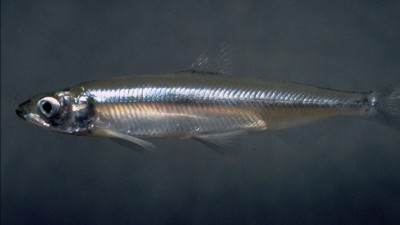
Rainbow Smelt (lat. Osmerus eperlanus dentex)
An anadromous lake species. In the Far East it is usually called ‘zubar’ or ‘zubatka’.
Description. Smelts have large mouths with protruding lower jaw. They have strong teeth. The scales are relatively large. Smelts are recorded to grow up to 34 cm long and may weigh around 300 grams.
Status. Smelts are object of both fish trade and recreational fishing (especially, ice fishing).
Habitat and Behavior. Smelts are common for the Arctic Ocean and the Far East region: lowstream Amur (to Nikolaevsk), Commander Islands, Shantar Islands, Sakhalin, Kamchatka. Smelts tend to stay close to shore for the most part of the year. They feed mostly in saltish regions near the estuaries, where they catch crustaceans, chiromonid spawn and fry. Smelts reach sexual maturity in their 3 or 4 year. They come into the rivers under ice.
Since the smelts’ habitat is enormous, the spawning seasons vary. Massively coming upstream for spawning smelts become easy prey for predators (especially, the piscivorous birds) and fishers. Smelts become extremely careless when striving to get to spawning grounds, and after reaching those. It is easy to catch them with bare hands.
The weight gain is the most intensive in summer and autumn. When winter comes feeding becomes less active.
Smelts gather in the areas before the estuaries and stays there until the spawning migration begins. The spawning distance varies for different regions and depends on the suitable spawning ground locations.
In Amur smelts come upstream for 270 km; whereas as for the Primorye rivers, it only comes up 16 to 18 km. The spawning season begins in May – mid-June when the water temperature rises up to +4°С. The peak of the season falls in the temperature range of +6 to + 9°С.
Smelts spawn in currents. They lay eggs on rocks, pebbles, water plants, washed out riverside plants’ roots and bush branches reaching water. Sometimes eggs can be found in sand or muddy soils. The spawning grounds are not deep: 15 or 20 cm to a few meters. Smelt lays 35 to 60 thousand eggs. Many of them dry up and die due to water level fluctuations or are destroyed by predators (insects and fish).
Spawn hatches 15 to 20 days later and is washed downstream. At first it feeds on plankton, and then moves to bottom invertebrates and fish, including the fry of their own kind. Growth and maturity speed for different populations depends on the mix of food and climate conditions of their specific habitat region.
The Sea of Okhotsk: the Encyclopedia, 2015.
***
“Alive smelts are very beautiful. They have brownish green backs that are slightly transparent because the back scales do not have silver pigment inside. Their sides are silvery bluish; this silver stripe can be wider or narrower, and can shine more or less brightly depending on the habitat. It begins from the gill cover and goes all the way to the tail, gradually narrowing down. Young fish do not have it. This silvery shade of the sides depend on the pigment of the skin itself underneath the scales. The ventral membrane is also silver; and on the inside of the gill cover there is an area of black pigment showing up as more or less saturated spots. The smelt fins are whitish, and can be darker or brighter in shade. Males can be identified by a more protruding lower jaw, and when spawning – by a large number of knobs on their heads and lower paired fins.”
Extract taken from: Leonid Sabaneev, Fishes of Russia, vol. 1.